MCQ
Choose the correct answers from the given four options : Let $\text{f(x)}=|\sin\text{x}|.$ Then :
  • A
    $f$ is everywhere differentiable.
  • $f$ is everywhere continuous but not differentiable at $\text{x}=\text{n}\pi,\text{n}\in\text{Z}.$
  • C
    $f$ is everywhere continuous but not differentiable at $\text{x}=(2\text{n}+1)\frac{\pi}{2},\text{n}\in\text{Z}.$
  • D
    None of these.

Answer

Correct option: B.
$f$ is everywhere continuous but not differentiable at $\text{x}=\text{n}\pi,\text{n}\in\text{Z}.$
Let $\text{u(x)}=\sin\text{x}$ and $\text{v(x)}=|\text{x}|$
$\therefore\ \text{f(x)}=\text{vou(x)}=\text{v}[\text{u(x)}]$
Since, $u(x)$ and $v(x)$ both are continuous functions.
Hence, $f(x) = \text{vou(x)}$ is also a continuous function but $v(x)$ is not differentiable at $x = 0.$
So, $f(x)$ is not differentiable where $\sin\text{x}=0$
$\Rightarrow\ \text{x}=\text{n}\pi,\text{n}\in\text{Z}$
Hence, $f(x)$ is continuous everywhere but not differentiable at $\text{x}=\text{n}\pi,\text{n}\in\text{Z}.$

Need a full question paper?

Generate a complete, print-ready paper with questions like this in minutes — across 16+ boards, with answer keys.

Start Generating Free

Similar questions

A and B are two points and C is any point collinear with A and B. IF AB=10, BC=5, then AC is equal to:
The value of $\int\limits_0^1 {\left( {\prod\limits_{r = 1}^n {(x + r)} } \right)\,\,\left( {\sum\limits_{k = 1}^n {\frac{1}{{x + k}}} } \right)\,dx} $ equals
Let $\Omega$ be the set of all $3 \times 3$ symmetric matrices all of whose entries are either $0$ or $1$ . Five of these entries are $1$ and four of them are $0$ .

$1.$ The number of matrices in $\Omega$ is

$(A)$ $12$ $(B)$ $6$ $(C)$ $9$ $(D)$ $3$

$2.$ The number of matrices $A$ in $\Omega$ for which the system of linear equations

$A\left[\begin{array}{l}x \\ y \\ z\end{array}\right]=\left[\begin{array}{l}1 \\ 0 \\ 0\end{array}\right]$ has a unique solution, is

$(A)$ less than $4$

$(B)$ at least $4$ but less than $7$

$(C)$ at least $7$ but less than $10$

$(D)$ at least $10$

$3.$ The number of matrices $A$ in $\Omega$ for which the system of linear equations

$A\left[\begin{array}{l}x \\ y \\ z\end{array}\right]=\left[\begin{array}{l}1 \\ 0 \\ 0\end{array}\right]$ is inconsistent, is

$(A)$ $0$ $(B)$ more than $2$ $(C)$ $2$ $(D)$ $1$
Find the value of $x$ if $\begin{bmatrix}3&\text{3}\\2&\text{x}^2\end{bmatrix}=\begin{bmatrix}5&3\\3&2\end{bmatrix}.$
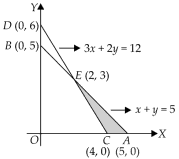
The maximum value of $Z=5 x+3 y$, if the shaded region represents the feasible region, is
Image
Distance of the point $(1, 2, 3)$ from the co-ordinate axes are
Let $f(x)$ and $g(x)$ be differentiable functions on $R$ . If $h(x) = f(g(f(x)))$ , where $f(2) = 1$ , $g(1) = 2$ and $f'(2) = g'(1) = 4$ , then $h'(2)$ is equal to 
If $a + b + c = 0,$ then $a \times b =$
$\int \limits_{-\pi}^{\pi}|\pi-| x || d x$ is equal to :
solve $\frac{{1 - \left| x \right|}}{{2 - \left| x \right|}} \ge 0$