MCQ
Choose the correct name for compound given below:
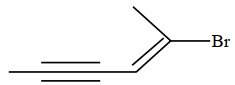
  • A
    $(4E)-5-$Bromo-hex$-4-$en$-2-$yne
  • B
    $(2E)-2-$Bromo-hex$-4-$yn$-2-$ene
  • $(2E)-2-$Bromo-hex$-2-$en$-4-$yne
  • D
    $(4E)-5-$Bromo-hex$-2-$en$-4-$yne

Answer

Correct option: C.
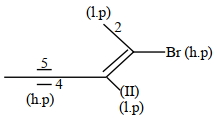
$(2E)-2-$Bromo-hex$-2-$en$-4-$yne
c
$h.p.$ $\Rightarrow$ higher priority

$l.p.$ $\Rightarrow$ lower priority

$2 \mathrm{E}-2$ - bromo hex $-2 -$ en $-4-$yne
Need a full question paper?

Generate a complete, print-ready paper with questions like this in minutes — across 16+ boards, with answer keys.

Start Generating Free

Similar questions

Nitrogen gas is obtained by thermal decomposition of .... .
The halogen that most easily reduced is
What will be the $pH$ of an aqueous solution of $1.0\, M$ ammonium formate ? (Given: $pK_a = 3.8$ and $pK_b = 4.8$)
The lightest metal is
The $p^H$ of a solution obtained by mixing $10\  ml$ of $0.1\  M$ $HCl$ and $40\  ml$ of $0.2\  M$ $H_2SO_4$ is (Given $log 17=$  $1.23$, $log 5=$  $0.7$, $log 10=$  $1$)
The specific conductance of staturated solution of silver bromide is $\kappa $ $S\, cm^{-1}$. The limiting ionic conductances for $Ag^+$ and $Br^-$ are $x$ and $y$ $S\, cm^2\, mol^{-1}$ respectively then the solubility of silver bromide (in $g/L$) will be $(Ag = 108, Br = 80)$
The $IUPAC$ name of 

$\begin{array}{*{20}{c}}
  {\,\,\,\,\,\,\,\,\,\,\,\,\,\,\,\,\,\,\,\,\,\,\,\,\,\,\,\,\,\,\,\,\,\,\,\,\,\,\,\,C{H_3}} \\ 
  {\,\,\,\,\,\,\,\,\,\,\,\,\,\,\,\,\,\,\,\,\,\,\,\,\,\,\,\,\,\,\,\,\,\,\,|} \\ 
  {C{H_3} - CH - C{H_2} - C - C{H_3}} \\ 
  {\,\,\,|\,\,\,\,\,\,\,\,\,\,\,\,\,\,\,\,\,\,\,\,\,\,\,\,\,\,\,\,\,\,\,\,|} \\ 
  {\,\,\,\,\,\,\,OH\,\,\,\,\,\,\,\,\,\,\,\,\,\,\,\,\,\,\,\,\,\,\,\,\,\,OH\,} 
\end{array}$ and $\begin{array}{*{20}{c}}
  {C{H_2} - CH - C{H_2}} \\ 
  {|\,\,\,\,\,\,\,\,\,\,\,\,\,\,|\,\,\,\,\,\,\,\,\,\,\,\,\,\,|\,\,\,\,\,} \\ 
  {CN\,\,\,\,\,\,\,\,CN\,\,\,\,\,\,\,\,CN\,\,} 
\end{array}$
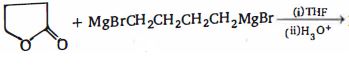
Product of the reaction is
The solubility of $CO_2$ in water increases with
In which of the following equilibrium systems is the rate of the backward reaction favoured by increase of pressure