MCQ
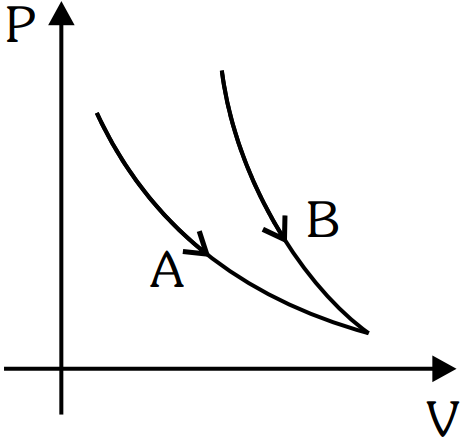
Choose the correct statement for processes A & B shown in figure.
Image
  • A
    PV$\gamma$ = k for process B and PV = k for process A.
  • B
    PV = k for process B and A.
  • C
    $\frac{ P ^{\gamma-1}}{T^\gamma}= k$ for process B and $T = k$ for process A .
  • D
    $\frac{ T ^\gamma}{ P ^{\gamma-1}}= k$ for process A and $PV = k$ for process B .
Answer

(A & C)
Steeper curve (B) is adiabatic
Adiabatic $\Rightarrow P^v=$ const.
Or $P \left(\frac{ T }{ P }\right)^v=$ const.
$
\frac{T^v}{P^{v-1}}=\text { const. }
$
Curve (A) is isothermal
$T =$ const.
$
PV=\text { const. }
$

Need a full question paper?

Generate a complete, print-ready paper with questions like this in minutes — across 16+ boards, with answer keys.

Start Generating Free

Similar questions

An engine of a train, moving with uniform acceleration, passes the signal-post with velocity $u$ and the last compartment with velocity $v$. The velocity with which middle point of the train passes the signal post is
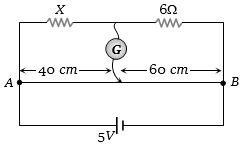
In the circuit shown, a meter bridge is in its balanced state. The meter bridge wire has a resistance $0.1\, ohm/cm$. The value of unknown resistance $X$ and the current drawn from the battery of negligible resistance is
Three capacitors, each of $3\,\mu F$, are provided. These cannot be combined to provide the resultant capacitance of.........$\mu F$
Resistance of a carbon resistor determined from colour codes is $(22000 \pm 5 \%) \Omega$. The colour of third band must be :
The ratio of the energy of an $X-$ ray photon of wavelength $1 Å$ to that of visible light of wavelength $5000 Å$ is
For $LED's$  to emit light in visible region of electromagnetic light, it should have energy band gap in the range of
The dispersion for a medium of wavelength $\lambda$ is $D$, then the dispersion for the wavelength $2 \lambda$ will be
A hollow sphere has inner volume half the outer volume. Its $4/5\,th$ part is submerged when placed in water. The density of material is
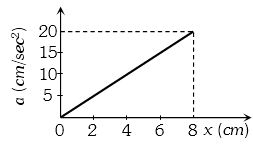
A 10kg mass moves along $x-$axis. Its acceleration as a function of its position is shown in the figure. What is the total work done on the mass by the force as the mass moves from $x = 0$ to $x = 8\,cm$
Two harmonic waves moving in the same direction superimpose to form a wave $\mathrm{x}=\mathrm{a} \cos (1.5 \mathrm{t}) \cos (50.5 \mathrm{t})$ where $t$ is in seconds. Find the period with which they beat (close to nearest integer)