MCQ
Choose the correct statement for processes $A$  & $B$ shown in figure.
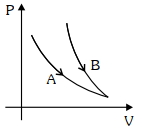
  • $\mathrm{PV}^\gamma=\mathrm{k}$ for process $\mathrm{B}$ and $\mathrm{PV}=\mathrm{k}$ for process $\mathrm{A}$.
  • B
    $\mathrm{PV}=\mathrm{k}$ for process $\mathrm{B}$ and $\mathrm{A}$.
  • C
    $\frac{P^{\gamma-1}}{T^\gamma}=k$ forprocess $B$ and $T=k$ for process $A$
  • D
    $\frac{T^\gamma}{P^{\gamma-1}}=k$ for process $A$ and $P V=k$ for process $B$.
Answer

Correct option: A.
$\mathrm{PV}^\gamma=\mathrm{k}$ for process $\mathrm{B}$ and $\mathrm{PV}=\mathrm{k}$ for process $\mathrm{A}$.
a
Steeper curve $(B)$ is adiabatic

Adiabatic $\Rightarrow \mathrm{PV}^{\prime}=$ const.

Or $\mathrm{P}\left(\frac{\mathrm{T}}{\mathrm{P}}\right)^{\mathrm{r}}=$ const.

$\frac{\mathrm{T}^v}{\mathrm{P}^{v-1}}=\text { const. }$

Curve $(A)$ is isothermal

$\mathrm{T}=$ const.

$\mathrm{PV}=$ const.

Need a full question paper?

Generate a complete, print-ready paper with questions like this in minutes — across 16+ boards, with answer keys.

Start Generating Free

Similar questions

A motor car moving with a uniform speed of $20\,m/\sec $ comes to stop on the application of brakes after travelling a distance of $10\,m$ Its acceleration is..........$m/{\sec ^2}$
In an adiabatic change, the pressure P and temperature T of a diatomic gas are related by the relation $\text{P}\propto\text{T}^{\text{c}}$ where c equals:
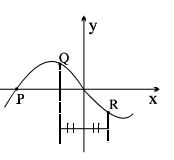
At a certain moment, the photograph of a string on which a harmonic wave is travelling to the right is shown. Then, which of the following is true regarding the velocities of the points $P, Q$ and $R$ on the string.
A cyclist turns around a curve at $15\, miles/hour$. If he turns at double the speed, the tendency to overturn is
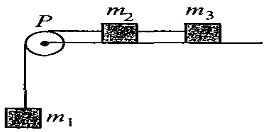
A system consists of three masses $m_1 , m_2$ and $m_3$ connected by a string passing over a pulley $P.$ The mass $m_1$ hangs freely and $m_2$ and $m_3$ are on a rough horizontal table (the coefficient of friction $= \mu ).$ The pulley is frictionless and of negligible mass. The downward acceleration of mass $m_1$ is $(Assume\, m = m_2 = m_3 = m)$ 
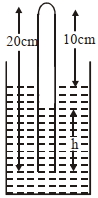
A $20 \,cm$ long tube is closed at one end. It is held vertically, and its open end is dipped in water until only half of it is outside the water surface. Consequently, water rises in it by height $h$ as shown in the figure. The value of $h$ is closest to .............. $\,m / s$ (assume that the temperature remains constant, $P _{\text {armosphere }}=10^5 \,N / m ^2$, density. of water $=10^3 \,kg / m ^3$, and acceleration due to gravity $g =10 \,m / s ^2$ )
A body moves from rest with a constant acceleration of $5\,m/{s^2}$. Its instantaneous speed (in $m/s)$ at the end of $10\, sec$ is
Air is pumped into a balloon, of initial volume $V$ , until its diameter has doubled. If the atmospheric pressure is $p$ , what is the work done against the atmosphere ? 
When a ceiling fan is switched off its angular velocity reduces to $50\%$ while it makes $ 36$ rotations. How many more rotation will it make before coming to rest (Assume uniform angular retardation)
The weight of an object in the coal mine, sea level, at the top of the mountain are ${W_1},\;{W_2}$ and ${W_3}$ respectively, then