MCQ
Choose the CORRECT statement.
  • A
    The force between two nucleons hold the protons and the neutrons inside the nucleus.
  • B
    Nuclear force obey inverse square law.
  • C
    Weak nuclear force is weaker than gravitational force.
  • D
    Electromagnetic force does not depend on intervening medium.
Answer

Need a full question paper?

Generate a complete, print-ready paper with questions like this in minutes — across 16+ boards, with answer keys.

Start Generating Free

Similar questions

An electron travelling with a speed of $5 \times 10^3 m / s$ passes through an electric field with an acceleration of $10^{12} m / s ^2$. How long will it take for electron to double its speed?
A body of mass 100 g is revolving in a horizontal circle. If its frequency of rotation is 3.5 r.p.s. and radius of circular path is 0.5 m, the angular speed of the body is
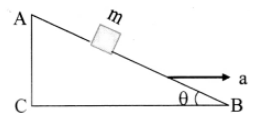
A block of mass m is placed on a smooth inclined wedge ABC of inclination θ as shown in the figure. The wedge is given an acceleration ‘a’ towards the right. The relation between a and θ for the block to remain stationary on the wedge isImage 
The electric intensity in air at a point $20 \ cm$ from a point charge $Q$ coulombs is $4.5 \times 10^5 N/ C.$ The magnitude of $Q$ is
A plane sound wave travelling with velocity $v$ in a medium $A$ reaches a point on the interface of medium $A$ and medium $B$. If velocity of sound in medium $B$ is $2 v$, the angle of incidence for total internal reflection of the wave will be greater than $\left(\sin 30^{\circ}=0.5\right.$ and $\left.\sin 90^{\circ}=1\right)$
Which of the following is NOT a projectile?
If the particle is at rest, then the x – t graph can be only
Magnetic lines of force originate from …………… pole and end at …………….. pole outside the magnet.
The projectile attains maximum height when it is projected at an angle of
At t = 0, a particle starts moving from origin with velocity $5.0 im / s$ and it moves in x-y plane due to a force having a constant acceleration of $(2.0 \hat{ i }+3.0 \hat{ j }) m / s ^2$.Find the coordinate of the particle at t = 6 s.