Answer

Correct option: B.
b
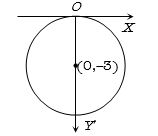
(b) Centre is $(0, -3)$ and $R = \sqrt {{0^2} + 9 + 0} = 3$.

Need a full question paper?

Generate a complete, print-ready paper with questions like this in minutes — across 16+ boards, with answer keys.
Start Generating Free

Similar questions

Let the probability of getting head for a biased coin be $\frac{1}{4}$. It is tossed repeatedly until a head appears. Let $N$ be the number of tosses required. If the probability that the equation $64 x ^2+5 Nx +1=0$ has no real root is $\frac{ p }{ q }$, where $p$ and $q$ are co-prime, then $q-p$ is equal to
Let $g(x)=3 f\left(\frac{x}{3}\right)+f(3-x)$ and $f^{\prime \prime}(x)>0$ for all $\mathrm{x} \in(0,3)$. If $\mathrm{g}$ is decreasing in $(0, \alpha)$ and increasing in $(\alpha, 3)$, then $8 \alpha$ is
Let ${S_n} = 1 + q + {q^2} + ..... + {q^n}$ and ${T_n} = 1 + \left( {\frac{{q + 1}}{2}} \right) + {\left( {\frac{{q + 1}}{2}} \right)^2} + ...... + {\left( {\frac{{q + 1}}{2}} \right)^n}$ where $q$ is a real number and $q \ne 1$. If ${}^{101}{C_1} + {}^{101}{C_2}.{S_1} + ...... + {}^{101}{C_{101}}.{S_{100}} = \alpha\, {T_{100}}$ then $\alpha $ is equal to
Let $S$ be the set of all $(\lambda, \mu)$ for which the vectors $\lambda \hat{ i }-\hat{ j }+\hat{ k }, \hat{ i }+2 \hat{ j }+\mu \hat{ k }$ and $3 \hat{ i }-4 \hat{ j }+5 \hat{ k }$, where $\lambda-\mu=5$, are coplanar, then $\sum_{(\lambda, \mu) \in S} 80\left(\lambda^2+\mu^2\right)$ is equal to :
The equation of circle whose diameter is the line joining the points $(-4, 3)$ and $(12, -1)$ is
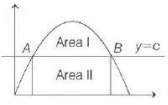
The figure shows a portion of the graph $y=2 x-4 x^3$.The line $y=c$ is such that the areas of the regions marked $I$ and $II$ are equal. If $a, b$ are the $x$-coordinates of $A, B$ respectively, then $a+b$ equals
The value of $\int {{e^{2x}}(2\sin 3x + 3\cos 3x)\,\,dx} $ is
Let $f:[0, \infty) \rightarrow R$ be a continuous function such that $f(x)=1-2 x+\int_0^x e^{x-t} f(t) d t$ for all $x \in[0, \infty)$. Then, which of the following statement (s) is (are) $TRUE$?

$(A)$ The curve $y=f(x)$ passes through the point $(1,2)$

$(B)$ The curve $y=f(x)$ passes through the point $(2,-1)$

$(C)$ The area of the region $\left\{(x, y) \in[0,1] \times R: f(x) \leq y \leq \sqrt{1-x^2}\right\}$ is $\frac{\pi-2}{4}$

$(D)$ The area of the region $\left\{(x, y) \in[0,1] \times R: f(x) \leq y \leq \sqrt{1-x^2}\right\}$ is $\frac{\pi-1}{4}$

The angle between the pair of tangents from the point $(1, 1/2)$ to the circle $x^2 + y^2 + 4x + 2y -4=0$ is-
In a triangle $ABC$ the value of $\angle A$ is given by $5\cos A + 3 = 0$, then the equation whose roots are $\sin A$ and $\tan A$ will be