MCQ
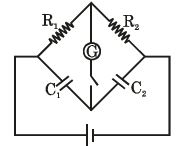
Circuit shown is in steady state, now when switch is closed, galvanometer shows no deflection, then correct relation is
  • $\frac{{{R_1}}}{{{R_2}}} = \frac{{{C_2}}}{{{C_1}}}$
  • B
    $\frac{{{R_1}}}{{{R_2}}} = \frac{{{C_1}}}{{{C_2}}}$
  • C
    $R_1R_2 = C_1C_2$
  • D
    ${R_1}\sqrt {{C_1}}  = {R_2}\sqrt {{C_2}} $

Answer

Correct option: A.
$\frac{{{R_1}}}{{{R_2}}} = \frac{{{C_2}}}{{{C_1}}}$
a
$\mathrm{C}_{1}$ and $\mathrm{C}_{2}$ are in series with battery so charge on both will be same

let it is $=\mathrm{q}$

and let current in resistance branch $=\mathrm{i}$

$\therefore \mathrm{V}_{\mathrm{C}_{1}}=\mathrm{i} \mathrm{R}_{1} \Rightarrow \frac{\mathrm{q}}{\mathrm{C}_{1}}=\mathrm{i} \mathrm{R}_{1} \Rightarrow \mathrm{q}=\mathrm{ir}_{1} \mathrm{C}_{1}$

similarly $\mathrm{V}_{\mathrm{C}_{2}}=\mathrm{i} \mathrm{R}_{2} \Rightarrow \frac{\mathrm{q}}{\mathrm{C}_{2}}=\mathrm{i} \mathrm{R}_{2} \Rightarrow \mathrm{q}=\mathrm{i} \mathrm{R}_{2} \mathrm{C}_{2}$

$\therefore \quad \mathrm{iR}_{1} \mathrm{C}_{1}=\mathrm{i} \mathrm{R}_{2} \mathrm{C}_{2}$

$\Rightarrow \frac{\mathrm{R}_{1}}{\mathrm{R}_{2}}=\frac{\mathrm{C}_{2}}{\mathrm{C}_{1}}$
Need a full question paper?

Generate a complete, print-ready paper with questions like this in minutes — across 16+ boards, with answer keys.

Start Generating Free

Similar questions

The formula for induced $e.m.f.$ in a coil due to change in magnetic flux through the coil is (here $A$ = area of the coil, $B$ = magnetic field)
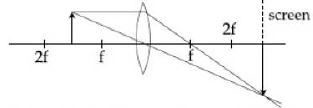
Formation of real image using a biconvex lens is shown below:

If the whole set up is immersed in water without disturbing the object and the screen positions, what will one observe on the screen?

The speed of a satellite in a circular orbit of radius $R_0$ around the earth is $v_0$. Another satellite is in an elliptic orbit around the earth. If the minimum and maximum speeds of the second satellite are $\alpha v_0$ and $\beta v_0$ respectively, then its time period is
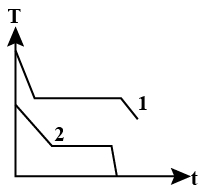
Two different liquids of same mass are kept in two identical vessels, which are placed in a freezer that extracts heat from them at the same rate causing each liquid to transform into a solid. The schematic figure below shows the temperature $T$ versus time $t$ plot for the two materials. We denote the specific heat in the liquid states to be $C_{L 1}$ and $C_{L 2}$ for materials 1 and 2, respectively and latent heats of fusion $U_1$ and $U_2$, respectively. Choose the correct option.
Angle of minimum deviation for a prism of refractive index $1.5$ is equal to the angle of prism. The angle of prism is.......$^o$ ($cos 41^o  = 0.75$)
A rod with circular cross-section area $2\,cm ^2$ and length $40\,cm$ is wound uniformly with $400$ turns of an insulated wire. If a current of $0.4\,A$ flows in the wire windings, the total magnetic flux produced inside windings is $4\,\pi \times 10^{-6}\,Wb$. The relative permeability of the rod is (Given : Permeability of  vacuum $\left.\mu_0=4 \pi \times 10^{-7} \;NA ^{-2}\right)$
A $2\,kg$ block slides on a horizontal floor with a speed of $4\, m/s$. It strikes a  uncompressed spring, and compresses it till the block is motionless. The kinetic friction  force is $110\,N$ and spring constant is $1000\, N/m$. The spring compresses by ........ $cm$
A $100\%$ efficient transformer has $100$ turns in the primary and $25$ turns in its secondary coil. If the current in the secondary coil is $4$ amp, then the current in the primary coil is.....$ amp$
The mean free path of gas molecules depends on $(d =$ molecular diameter$)$
Given below are two statements :

Statement$-I:$ Acceleration due to gravity is different at different places on the surface of earth.

Statement$-II:$ Acceleration due to gravity increases as we go down below the earth's surface.

In the light of the above statements, choose the correct answer from the options given below