Question
Classify connective tissue and give one example of each type.

Answer

The connective tissue is specialized to connect and anchor various body organs.
There are five types of connective tissues:
  1. Areolar: This tissue is a loose and cellular connective tissue. Its matrix consists of white collagen fibre and yellow elastic fibre. It joins skin to muscles, fills spaces inside organs and is found around muscles, blood vessels and nerves.
  2. Dense Regular Connective tissue: It is fibrous connective tissue having densely packed fibres and cells. It is the principal component of tendons, ligaments and aponeuroses.
  3. Adipose tissue: It is an aggregation of fat cells or adipocytes. The fat cells are arranged into lobules separated by partitions of collagen and elastin fibres. These are found abundant below the skin, between the internal organs and in yellow bone marrow.
  4. Skeletal tissue: It is a supporting tissue which includes cartilage and bone. Both these tissues form the endoskeleton of a vertebrate body. Cartilage is located in ear pinna, nose tip, epiglottis etc. Bone forms the endoskeleton in human beings and provides shape to the body.
  5. Fluid tissue: It links the different parts of the body and maintains continuity in the body. It includes blood and lymph.

Need a full question paper?

Generate a complete, print-ready paper with questions like this in minutes — across 16+ boards, with answer keys.
Start Generating Free

Similar questions

What is fractional distillation? What is the use of fractionating column in fractional distillation?
If the back of your hand is moistened with alcohol, you will find that it rapidly becomes dry. Why is it that while it is drying, your hand feels cool?
Describe the various cropping patterns.
What do you understand by the terms “balanced forces” and “unbalanced forces”? Explain with examples.
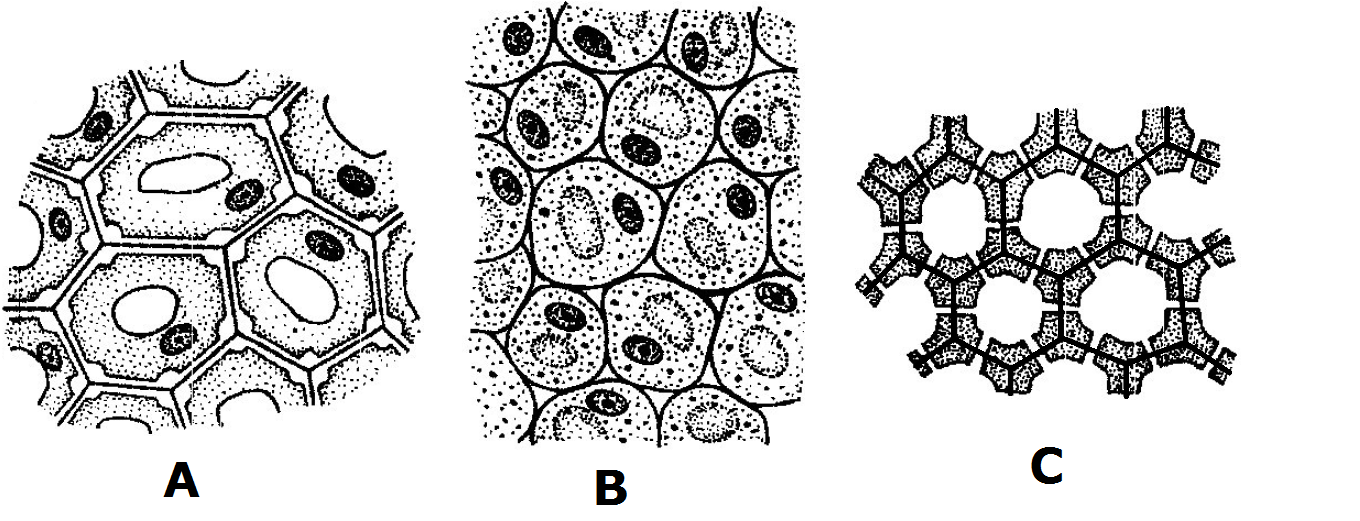
  1. Identify Figure A, B and C.
  2. Which one of them has heavy deposition of lignin?
  3. Which one of them provides both mechanical strength as well as flexibility?
  4. Which one of them can be modified to form air cavities in awuatic plants?
  5. Which one of them is commercially exploited to obtain Hemp and Jute?
Iron powder and sulphur powder were mixed together and divided into two parts A and B. When part A was heated strongly over a burner, then a substance C was formed. The part B was, however, not heated at all. When dilute hydrochloric acid was added to substance C, then gas D was evolved and when dilute hydrochloric acid was added to part B then gas E was evolved.
  1. What type of substance is B?
  2. What type of substance is C?
  3. Name the gas (i) D, and (ii) E?
  4. Write one characteristic property of gas D.
Draw a neat and labelled diagram of the human ear. With the help of this diagram, explain the construction and working of the human ear.
What is fractional distillation? What is the use of fractionating column in fractional distillation?
How does sound from a sound producing body travel through air to reach our ears? Illustrate your answer with the help of a labelled diagram.
How can reverberations in a big hall or auditotium be reduced?`