Question
Clear the difference between interference and diffraction.

Answer

S.No.InterferenceDiffraction
1.Interference occurs due to the superposition of two or more in phase waves of the same frequency.Diffractioon occurs due to superposition of secondary wavelets emitted from the same wave front.
2.In the interference pattern all illuminated fringes have the same intensity.In the diffraction pattern, the intensity of the central illuminated fringe is maximum and the intensity of other illuminated fringes is in decreasing order.
3.In the interference pattern of waves of equal amplitude the intensity of the dark fringe is zero.The dark fringes in the diffraction pattern are not to zero intensity
4.The fringes in an interference pattern are generally of equal width.The fringes in a diffraction pattern are always of   unequal width.
5.There is a good contrast between bright and dark particles.There is poor contrast in bright or fork fringes.

Need a full question paper?

Generate a complete, print-ready paper with questions like this in minutes — across 16+ boards, with answer keys.
Start Generating Free

Similar questions

Find the magnetic field B at the centre of a rectangular loop of length l and width b, carrying a current i.
A person travelling in a fast spaceship measures the distance between the earth and the moon. Is it the same, smaller or larger than the value quoted in this book?


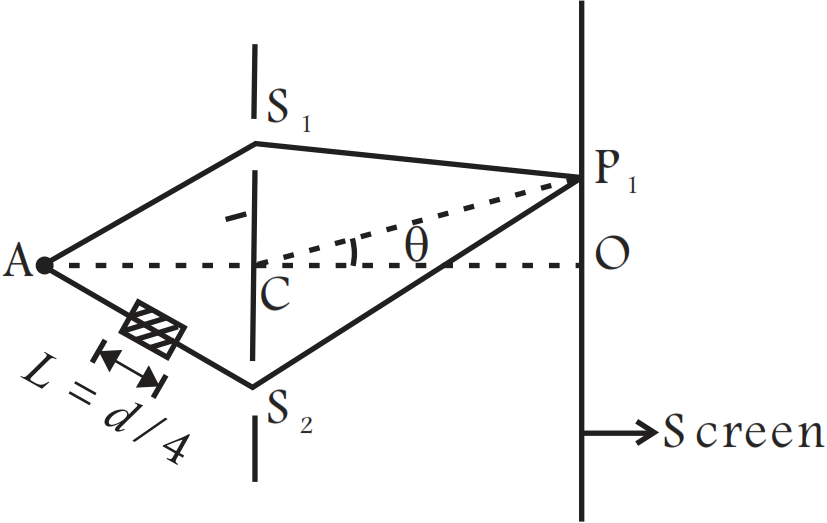
$\ce{AC = CO = D, S_1C = S_2C = d < < D}$
A small transparent slab containing material of $\mu = 1.5$ is placed along $AS_2 ($Fig$)$. What will be the distance from $O$ of the principal maxima and of the first minima on either side of the principal maxima obtained in the absence of the glass slab.
Determine the ‘effective focal length’ of the combination of the two lenses in if they are placed $8.0 \ cm$ apart with their principal axes coincident. Does the answer depend on which side of the combination a beam of parallel light is incident? Is the notion of effective focal length of this system useful at all.
An ideal gas is kept in a long cylindrical vessel fitted with a frictionless piston of cross$-$sectional area $10\ cm^{2 }$ and weight $1\ kg$. The length of the gas column in the vessel is $20\ cm$ The atmospheric pressure is $100\ kPa$ The vessel is now taken into a spaceship revolving round the earth as a satellite. The air pressure in the spaceship is maintained at $100\ kPa$ Find the length of the gas column in the cylinder.
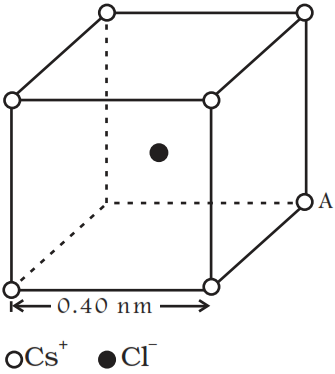
Fig. represents a crystal unit of cesium chloride $, \ce{CsCl}.$ The cesium atoms, represented by open circles are situated at the corners of a cube of side $0.40\ nm,$ whereas a $Cl$ atom is situated at the centre of the cube. The $Cs$ atoms are deficient in one electron while the $Cl$ atom carries an excess electron.
  1. What is the net electric field on the $Cl$ atom due to eight $Cs$ atoms?
  2. Suppose that the $Cs$ atom at the corner $A$ is missing. What is the net force now on the $Cl$ atom due to seven remaining $Cs$ atoms?
A paisa coin is made up of $Al-Mg$ alloy and weighs $0.75g$. It has a square shape and its diagonal measures $17\ mm.$ It is electrically neutral and contains equal amounts of positive and negative charges.
Treating the paisa coins made up of only Al, find the magnitude of equal number of positive and negative charges. What conclusion do you draw from this magnitude?
Consider the de Broglie wavelength of an electron and a proton. Which wavelength is smaller if the two particles have.
  1. The same speed.
  2. The same momentum.
  3. The same energy?.
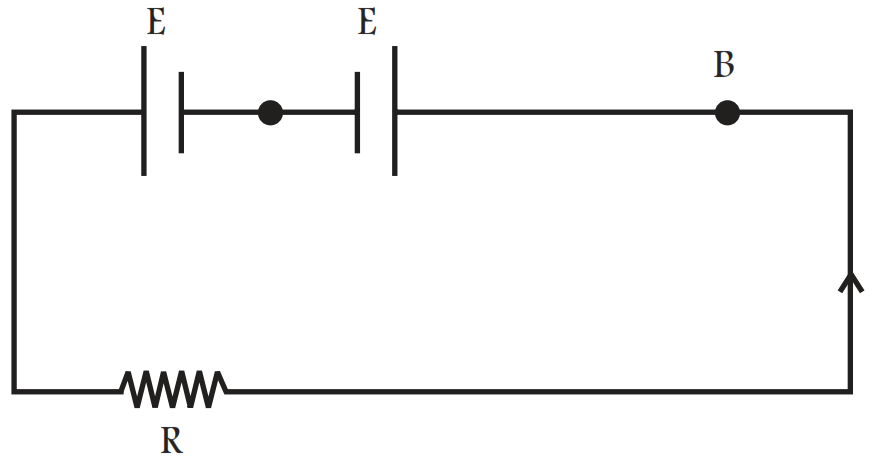
Two cells of same emf $E$ but internal resistance $r_1$ and $r_2$ are connected in series to an external resistor $R ($Fig$).$ What should be the value of $R$ so that the potential difference across the terminals of the first cell becomes zero.
A ball is thrown horizontally from a point $100\ m$ above the ground with a speed of $20m/s$. Find:
  1. The time it takes to reach the ground.
  2. The horizontal distance it travels before reaching the ground.
  3. The velocity $($direction and magnitude$)$ with which it strikes the ground.