MCQ
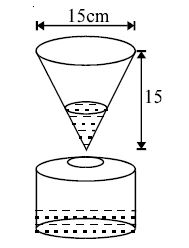
Coffee is draining from a conical filter, height and diameter both $15 \,\,cms$ into a cylinderical coffee pot diameter $15 \,\,cm$. The rate at which coffee drains from the filter into the pot is $100 \,\,cu cm /min$.The rate in $cm s/min$ at which the level in the pot is rising at the instant when the coffee in the pot is $10 \,\,cm$, is
  • A
    $\frac{9}{16\pi }$
  • B
    $\frac{25}{9\pi }$
  • C
    $\frac{5}{3\pi }$
  • $\frac{16}{9\pi }$

Answer

Correct option: D.
$\frac{16}{9\pi }$
d
For cylindrical pot  $V = \pi r^2h$

$\frac{{dV}}{{dt}} = \pi \left[ {{r^2}\frac{{dh}}{{dt}} + h\,\cdot\,2r\frac{{dr}}{{dt}}} \right]$(r = constant, $\frac{{dr}}{{dt}} = 0$)

hence,$100 = \pi r^2\frac{{dh}}{{dt}}$

$100 = \pi · \frac{{225}}{4} · \frac{{dh}}{{dt}}$(r = $\frac{{15}}{{2}} cm$)

$\frac{{dh}}{{dt}} = \frac{{400}}{{225\pi }} = \frac{{16}}{{9\pi }} cm/min$

Need a full question paper?

Generate a complete, print-ready paper with questions like this in minutes — across 16+ boards, with answer keys.

Start Generating Free

Similar questions

If a circle of constant radius $3k$ passes through the origin and meets the axes at $A$ and $B$, the locus of the centroid of the triangle $OAB$ is the circle
 Solve system of linear equations, using matrix method. $x-y+2 z=7$ ;  $3 x+4 y-5 z=-5$ ; $2 x-y+3 z=12$
The locus of the midpoint of the line segment joining the focus to a moving point on the parabola ${y^2} = 4ax$ is another parabola with the directrix
Let $S$ be the focus of the parabola $y ^2=8 x$ and let $PQ$ be the common chord of the circle $x^2+y^2-2 x-4 y=0$ and the given parabola. The area of the triangle $PQS$ is.
If the point of intersections of the ellipse $\frac{ x ^{2}}{16}+\frac{ y ^{2}}{ b ^{2}}=1$ and the circle $x ^{2}+ y ^{2}=4 b , b > 4$ lie on the curve $y^{2}=3 x^{2},$ then $b$ is equal to:
For $x \in(-1,1]$, the number of solutions of the equation $\sin ^{-1} x=2 \tan ^{-1} x$ is equal to
Let $\mathrm{H}_1, \mathrm{H}_2, \ldots, \mathrm{H}_{\mathrm{n}}$ be mutually exclusive and exhaustive events with $\mathrm{P}\left(\mathrm{H}_{\mathrm{i}}\right)>0, \mathrm{i}=1,2, \ldots, \mathrm{n}$. Let $\mathrm{E}$ be any other event with $0<\mathrm{P}(\mathrm{E})<1$.

$STATEMENT -1$ : $\mathrm{P}\left(\mathrm{H}_{\mathrm{i}} \mid \mathrm{E}\right)>\mathrm{P}\left(\mathrm{E} \mid \mathrm{H}_{\mathrm{i}}\right) \cdot \mathrm{P}\left(\mathrm{H}_{\mathrm{i}}\right)$ for $\mathrm{i}=1,2, \ldots, \mathrm{n}$ because

$STATEMENT$ $-2: \sum_{1=1}^{\mathrm{n}} \mathrm{P}\left(\mathrm{H}_{\mathrm{i}}\right)=1$

Given $A(1, 1)$ and $AB$ is any line through it cutting the $x-$ axis in $B$. If $AC$ is perpendicular to $AB$ and meets the $y-$ axis in $C$, then the equation of locus of mid- point $P$ of $BC$ is
$\int\limits_{\sin \,\theta }^{\cos \,\theta } f $ $( x tan \theta) dx$ is (where $ \theta \neq \frac{n \pi }{2},n\in I$)


If the vector $\vec b = 3\hat j + 4\hat k$ is written as the sum of a vector ${\vec {b_1}}$ , parallel to $\vec a = \hat i + \hat j$ and a vector ${\vec {b_2}}$ , perpendicular to $\vec a$ , then ${\vec {b_1}} \times {\vec {b_2}}$ is equal to