MCQ
Coherent sources are characterized by the same
  • A
    Phase and phase velocity
  • B
    Wavelength, amplitude and phase velocity
  • C
    Wavelength, amplitude and frequency
  • Both $(b)$ and $(c)$

Answer

Correct option: D.
Both $(b)$ and $(c)$
d
(d) Because in general phase velocity = wave velocity. But in case of complex waves (many waves together) phase velocity $ \ne $ wave velocity.
$\therefore $ If two waves have same $\lambda ,v;$ then they have same frequency too

Need a full question paper?

Generate a complete, print-ready paper with questions like this in minutes — across 16+ boards, with answer keys.
Start Generating Free

Similar questions

A plane sound waves passes from medium $1$ into medium $2$. The speed of sound in medium $1$ is $200\,m/s$ and in medium $2$ is $100 \,m/s$. The ratio of amplitude of the transmitted wave to that of incident wave is :-
A satellite is moving around the earth with speed $v$ in a circular orbit of radius $r$. If the orbit radius is decreased by $1\%$, its speed will
A bullet of mass $0.1\,kg$ moving horizontally with speed $400\,ms ^{-1}$ hits a wooden block of mass $3.9\,kg$ kept on a horizontal rough surface. The bullet gets embedded into the block and moves $20\,m$ before coming to rest. The coefficient of friction between the block and the surface is $........$ $\left(\text { Given } g=10 \,ms ^2\right. \text { ) }$
Dimensional formula of resistivity is
Two forces having magnitude $A$ and $\frac{ A }{2}$ are perpendicular to each other. The magnitude of their resultant is
The initial velocity of a particle is $u$ (at $t = 0$) and the acceleration ${n^{th}}$ is given by $at$. Which of the following relation is valid
A $5\, m$ long aluminium wire ($Y = 7 \times {10^{10}}N/{m^2})$ of diameter $3\, mm$ supports a $40\, kg$ mass. In order to have the same elongation in a copper wire $(Y = 12 \times {10^{10}}N/{m^2})$ of the same length under the same weight, the diameter should now be, in $mm.$
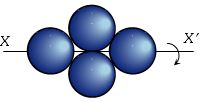
The moment of inertia of a sphere (mass $M$ and radius $R$ ) about it's diameter is $I$. Four such spheres are arranged as shown in the figure. The moment of inertia of the system about axis $XX'$ will be
A tube of length $L$ is filled completely with an incompressible liquid of mass $M$ and closed at both the ends. The tube is then rotated in a horizontal plane about one of its ends with a uniform angular velocity $\omega $. The force exerted by the liquid at the other end is
A liquid boils when its vapour pressure equals