MCQ
Colour of acidified $K _2Cr_2O_7$ is not changed by
- A$H_2O_2$
- B$Sn^{2+}(aq.)$
- ✓$HF$
- D$HBr$
The oxidation state of $Cr$ in $K _2 Cr _2 O _7$ is calculated as :
$2+2 x +(-2) \times 7=0$
$\Rightarrow 2+2 x -14=0$
$\Rightarrow 2 x -12=0$
$\Rightarrow 2 x =+12$
$\Rightarrow x =+6$
$\therefore$ Oxidations state of $Cr =+3$
Potassium dichromate reacts with hydrogen fluoride to produce potassium fluorotrioxochromate $(VI)$ and water. The reaction involved is :
$K _2 Cr _2 O _7+2 HF \rightarrow 2 K \left[ CrO _3 F \right]+ H _2 O$
The oxidation state of $Cr$ in $K \left[ CrO _3 F \right]$ can be calculated as follows:
$+1+ x +(-2) \times 3+(-1)=0$
$\Rightarrow+1+ x -6-1=0$
$\Rightarrow x -6=0$
$\Rightarrow x =+6$
$\therefore$ Oxidations state of $Cr =+3$
Since, there is no change in the oxidation state of $Cr$ in the reactant and in the product, the color of the solution doesn't change. Therefore, the color of acidified $K _2 Cr _2 O _7$ is not changed by $HF$.
Generate a complete, print-ready paper with questions like this in minutes — across 16+ boards, with answer keys.
$Zn | ZnSO_4 \,(0.01\, M) | | CuSO_4\,(1.0\, M) | Cu$
When the concentration of $ZnSO_4$ is $1.0\,M$ and that of $CuSO_4$ is $0.01\,M$, the $emf$ changed to $E_2$ What is the relation between $E_1$ and $E_2$?
$\text { [en }= H _2 NCH _2 CH _2 NH _2 \text { ] }$
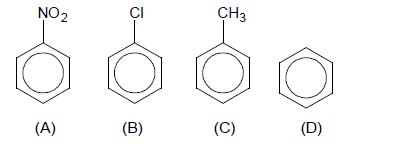
$\begin{gathered}
{\left[ {Al{{\left( {{H_2}O} \right)}_6}} \right]^{ + 3}} + HCO_3^ - \rightleftarrows {\left[ {Al{{\left( {{H_2}O} \right)}_5}OH} \right]^{ + 2}} + {H_2}C{O_3} \hfill \\
\,\,\,\,\,\,\,\,\,\,\,\,(A)\,\,\,\,\,\,\,\,\,\,\,\,\,\,\,\,\,\,\,\,(B)\,\,\,\,\,\,\,\,\,\,\,\,\,\,\,\,\,\,\,\,\,\,\,\,\,\,\,\,\,\,\,\,\,\,\,\,\,(C)\,\,\,\,\,\,\,\,\,\,\,\,\,\,\,\,\,\,\,\,\,\,\,(D) \hfill \\
\end{gathered} $
species behaving as bronsted -lowry acid are
