Question
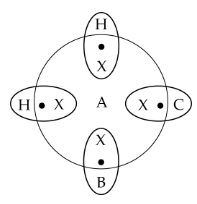
✓
Answer
A : 3-Carbon, B : 2-Hydrogen, or 5. Hydrogen, C : 3-Hydrogen or 5. Hydrogen
Need a full question paper?
Generate a complete, print-ready paper with questions like this in minutes — across 16+ boards, with answer keys.
Explore more
Similar questions
| Column A | Column B |
| (1) Pb2+ | (a) Reddish brown precipitate |
| (2) Fe2+ | (b) White insoluble in excess of ammonium hydroxide |
| (3) Zn2+ | (c) Dirty green precipitate |
| (4) Fe3+ | (d) White soluble in excess of ammonium hydroxide |
| (e) White insoluble in excess of sodium hydroxide |
Given below in column A is a schematic diagram of an apparatus for the laboratory preparation of hydrogen chloride. Identify the parts labelled as A, B and C with the correct options from the column B.
| Column A | Column B |
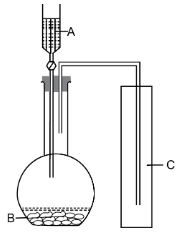 | 1. Sodium Chloride |
| 2. Calcium carbonate | |
| 3. Sulphuric acid | |
| 4. Acetic acid | |
| 5. Hydrogen chloride |
Given below in column A is a schematic diagram which shows the preparation of sulphuric acid by contact process. Identify the parts labelled as A, B and C with the correct options from the column B.
| Column A | Column B |
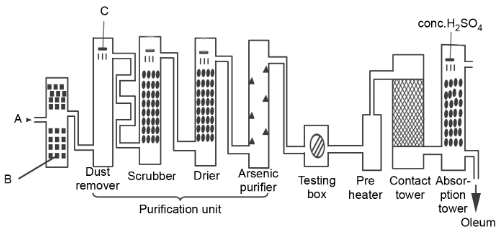 | 1. Air |
| 2. Sulphur or pyrite burners | |
| 3. Steam | |
| 4. Copper | |
| 5. Ammonia |
| Column A | Column B |
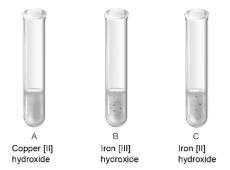 | 1. Pale blue |
| 2. Reddish brown | |
| 3. Dirty green | |
| 4. Yellow |
Given below in column A is a schematic graph of the ionization enthalpies and atomic numbers. Identify the elements labelled as A, B and C with the correct options from the column B.
| Column A | Column B |
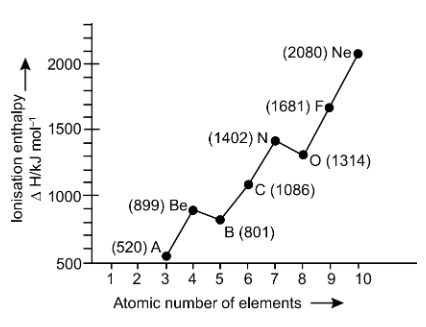 | (1) Lithium (2) Carbon (3) Boron (4) Chlorine |
| Column A | Column B |
| (a) Process by which ethane is obtained from ethene. | 1. Addition |
| (b) A hydrocarbon which contributes towards the greenhouse effect. | 2. Hydrolysis |
| (c) An organic compound whose functional group is carboxyl. | 3. Acetic acid |
| (d) The property of elements by virtue of which atoms of the element can link to each other in the form of a long chain or ring structure. | 4. Catenation |
| 5. Methane |
Given below in column A is a schematic diagram Fountain experiment. Identify the parts labelled as A, B and C with the correct options from the column B.
| Column A | Column B |
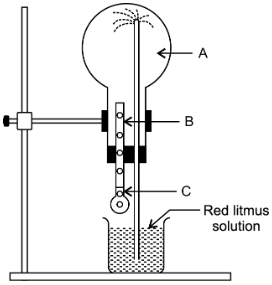 | 1. Hydrogen chloride |
| 2. Jet tube | |
| 3. Dropper | |
| 4. Water | |
| 5. Sodium chloride |
Match the following :
| Column A | Column B |
| 1. A substance that turns moist starch iodide paper blue. | A. Ammonium sulphate |
| 2. A compound which releases a reddish brown gas on reaction with concentrated sulphuric acid and copper turnings. | B. Lead carbonate |
| 3 . A solu tion of this compound gives a dirty green preci pi ta te with sodium hydroxide. | C. Chlorine |
| 4 . A compound which on heating with sodium hydroxide produces a gas which forms dense white fumes with hydrogen chloride. | D. Copper nitrate |
| 5 . A white solid which gives a yellow residue on heating. | E. Ferrous sulphate |
| Column A (Reactants) | Column B (Products) |
| (a) Chlorine reacts with excess of ammonia | 1. NCl3 + HCl |
| (b) Ammonia reacts with excess of chlorine | 2. Cu(NO3)2 + H2O + CO2 |
| (c) Reaction of ammonia with nitric acid | 3. Cu(NO3)2 + NO + H2O |
| (d) Copper carbonate reacts with dilute nitric acid | 4. NH4Cl + N2 |
| 5. NH4NO3 |
| Column A | Column A |
| (a) Period 4, group 2 | 1. Argon [Ar] |
| (b) Period 2, group 13 | 2. Calcium [Ca] |
| (c) Period 3, group zero | 3. Boron [B] |
| (d) Period 2, group 16 | 4. Oxygen [O] |