Question
| Column A | Column B |
| (a) Sodium chloride | 1. Increases |
| (b) Ammonium ion | 2. Decreases |
| (c) Electronegativity across the period | 3. Ionic bond |
| (d) Non-metallic character down the group | 4. Covalent and Coordinate bond |
| Column A | Column B |
| (a) Sodium chloride | 1. Increases |
| (b) Ammonium ion | 2. Decreases |
| (c) Electronegativity across the period | 3. Ionic bond |
| (d) Non-metallic character down the group | 4. Covalent and Coordinate bond |
Generate a complete, print-ready paper with questions like this in minutes — across 16+ boards, with answer keys.
| Column A | Column B |
| (a) Release of hydrogen gas on reacting with metals. | 1. Non-volatile acid |
| (b) Reaction with charcoal to form CO2 gas. | 2. Dehydrating agent |
| (c) Release of steamy fumes on reacting with blue vitriol. | 3. Acidic nature |
| (d) Forming HCl on reaction with metal chlorides | 4. Oxidising agent |
| Column A | Column B | ||
| (a) | Molar Mass | 1. | 6.022 × 10²³ particles/mol |
| (b) | Avogadro's Number | 2. | Simplest whole-number ratio of elements in a compound |
| (c ) | Empirical Formula | 3. | The maximum amount of product that can be formed from the given reactants |
| (d) | Molecular Formula | 4. | The mass of one mole of a substance |
| 5. | The actual formula of a molecule showing the number of atoms of each element | ||
| Column A | Column B |
| (a) Acid salt | 1. Sodium potassium carbonate |
| (b) Mixed salt | 2. Alum |
| (c) Complex salt | 3. Sodium carbonate |
| (d) Double salt | 4. Sodium zincate |
| 5. Sodium hydrogen carbonate |
| Column A | Column B |
| (1) Pb2+ | (a) Reddish brown precipitate |
| (2) Fe2+ | (b) White insoluble in excess of ammonium hydroxide |
| (3) Zn2+ | (c) Dirty green precipitate |
| (4) Fe3+ | (d) White soluble in excess of ammonium hydroxide |
| (e) White insoluble in excess of sodium hydroxide |
| Column A | Column B |
| (1) Covalent compound | (a) Methane (CH4) |
| (2) Non-polar | (b) Sodium chloride $( NaCl )$ |
| (3) Polar | (c) Chloride ion ( $Cl -$ ) |
| (4) Electrovalent compound | (d) Carbon dioxide (CO2) |
| (e) Hydrogen chloride ( HCl ) |
| Column A | Column B |
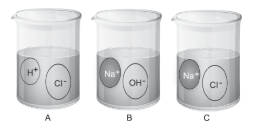 | (1) Base |
| (2) Salt | |
| (3) Acid | |
| (4) Water |
| Column A | Column B |
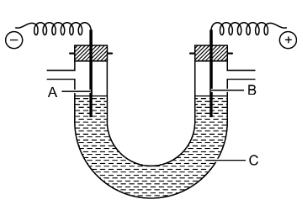 | 1. Copper |
| 2. Graphite | |
| 3. Aluminium. | |
| 4. Electrolytic mixture |
| Column A | Column B |
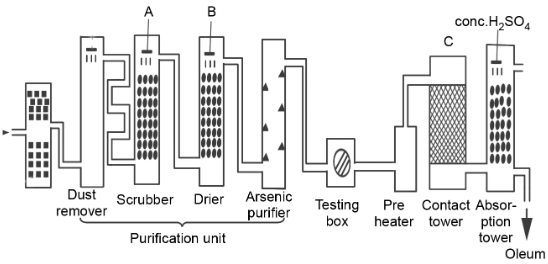 | 1. Cold water |
| 2. Conc. Sulphuric acid | |
| 3. Catalyst | |
| 4. Copper | |
| 5. Ammonia |
| Column I | Column II |
| (i) $P(NO_3)_2$ from $PbO$ (ii) $MgCl_2$ from $Mg$ (iii) $FeCl_3$from $Fe$ (iv) $NaNO_3$ from $NaOH$ (v) $ZnCO_3$ from $ZnSO_4$ |
(A) Simple displacement (B) Titration (C) Neutralisation (D) Precipitation (E) Combination |
| Column A | Column B |
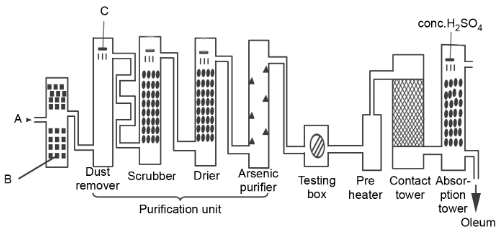 | 1. Air |
| 2. Sulphur or pyrite burners | |
| 3. Steam | |
| 4. Copper | |
| 5. Ammonia |