MCQ
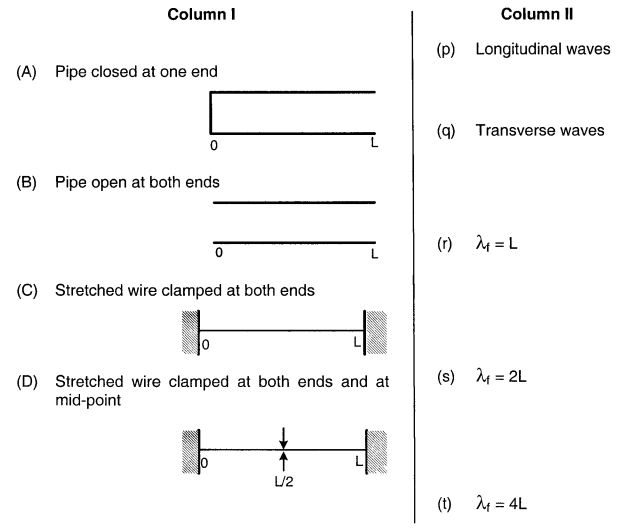
Column $I$ shows four systems, each of the same length $L$, for producing standing waves. The lowest possible natural frequency of a system is called its fundamental frequency, whose wavelength is denoted as $\lambda_{ f }$. Match each system with statements given in Column $II$ describing the nature and wavelength of the standing waves.
  • A
    $(A) \rightarrow p, r, \ and \ t,(B) \rightarrow p \ and \ q (C) \rightarrow q, \ and \ s,(D) \rightarrow  r \ and \ s$
  • B
    $(A) \rightarrow q \ and \ t,(B) \rightarrow r \ and \ s (C) \rightarrow p, \ and \ s,(D) \rightarrow  q \ and \ t$
  • $(A) \rightarrow p \ and \ t,(B) \rightarrow p \ and \ s (C) \rightarrow q, \ and \ s,(D) \rightarrow  q \ and \ r$
  • D
    $(A) \rightarrow q \ and \ t,(B) \rightarrow r \ and \ t (C) \rightarrow q \ and \ s,(D) \rightarrow  s \ and \ t$
Answer

Correct option: C.
$(A) \rightarrow p \ and \ t,(B) \rightarrow p \ and \ s (C) \rightarrow q, \ and \ s,(D) \rightarrow  q \ and \ r$
c
In case of pipe we can produce longitudinal waves and for strings we produce transverse waves.

$A \rightarrow(p, t):$ It is a closed organ pipe hence in case of fundamental vibrations length of the tube must be $\left(\frac{1}{4}\right)^{\text {th }}$ of the wavelength (half loop).

$\frac{\lambda_t}{4}=L \Rightarrow \lambda_t=4 L$

$B \rightarrow(p, s)$ : It is open organ pipe hence in case of fundamental vibrations length of the pipe must be half of the wavelength (one loop).

$\frac{\lambda_t}{2}=L \Rightarrow \lambda_t=2 L$

$C \rightarrow(q, s)$ : It is a case of string of length $L$ fixed at both ends.

In case of fundamental vibrations length of the pipe must be half of the wavelength (one loop).

$\frac{\lambda_t}{2}=L \Rightarrow \lambda_t=2 L$

$D \rightarrow(q, r):$ In this case mid-point is fixed hence half-length must form one loop.

$\frac{\lambda_t}{2}=\frac{L}{2} \Rightarrow \lambda_t=L$

Need a full question paper?

Generate a complete, print-ready paper with questions like this in minutes — across 16+ boards, with answer keys.

Start Generating Free

Similar questions

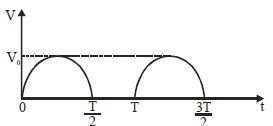
What will be $r.m.s.$ value of given $A.C.$ over one cycle.
In an experiment on simple pendulum to determine the acceleration due to gravity, a student measures the length of the thread as $63.2 \,cm$ and diameter of the pendulum bob as $2.256 \,cm$. The student should take the length of the pendulum to be ........... $cm$
What must be the lengths of steel and copper rods at $0^o C$ for the difference in their lengths to be $10\,cm$ at any common temperature? $(\alpha_{steel}=1.2 \times {10^{-5}} \;^o C^{-1})$ and $(\alpha_{copper} = 1.8 \times 10^{-5} \;^o C^{-1})$
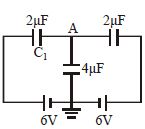
Three capacitors are connected as shown in fig. Then the charge on capacitor $C_1$ is.....$\mu C$
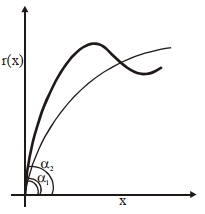
A projectile is launched from the origin in the $xy$ plane ( $x$ is the horizontal and $y$ is the vertically up direction) making an angle $\alpha$ from the $x$-axis. If its distance. $r =\sqrt{ x ^2+ y ^2}$ from the origin is plotted against $x$, the resulting curves show different behaviours for launch angles $\alpha_1$ and $\alpha_2$ as shown in the figure below. For $\alpha_1, r ( x )$ keeps increasing with $x$ while for $\alpha_2$, $r(x)$ increases and reaches a maximum, then decreases and goes through a minimum before increasing again. The switch between these two cases takes place at an angle $\alpha_c\left(\alpha_1 < \alpha_c < \alpha_2\right)$. The value of $\alpha_c$ is [ignore where $v_0$ is the initial speed of the projectile and $g$ is the acceleration due to gravity]
An athlete completes one round of a circular track of radius $R$ in $40 \,sec$. What will be his displacement at the end of $2 \,min$. $20 \,sec$
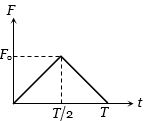
A particle of mass $m$ moving with velocity $u$ makes an elastic one dimensional collision with a stationary particle of mass $m$. They are in contact for a very short time $T$. Their force of interaction increases from zero to $F_0$ linearly in time $T/2$, and decreases linearly to zero in further time $T/2$. The magnitude of $F_0$ is
The weight of a body in water is one third of its weight in air. The density of the body is ....... $g / cm ^3$
For a triode ${r_p} = 10$kilo ohm and ${g_m} = 3$$milli mho.$ If the load resistance is double of plate resistance, then the value of voltage gain will be
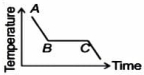
The portion $A B$ of the curve representing the state of matter denotes