Question
Column $II$ shows five systems in which two objects are labelled as $\mathrm{X}$ and $\mathrm{Y}$. Also in each case a point $\mathrm{P}$ is shown. Column $I$ gives some statements about $\mathrm{X}$ and/or $\mathrm{Y}$. Match these statements to the appropriate system$(s)$ from Column $II$.
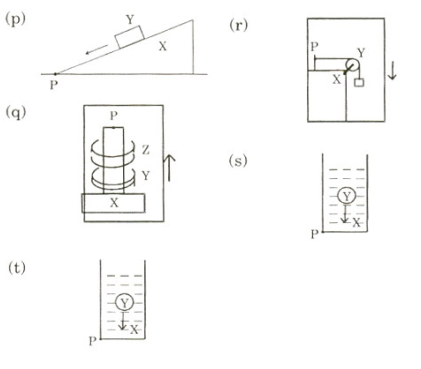
Column $I$ Column $II$
$(A)$ The force exerted by $\mathrm{X}$ on $\mathrm{Y}$ has a magnitude $\mathrm{Mg}$. $Image$ Block $Y$ of mass $M$ left on a fixed inclined plane $\mathrm{X}$, slides on it with a constant velocity.
$(B)$ The gravitational potential energy of $\mathrm{X}$ is continuously increasing. $Image$ Two ring magnets $\mathrm{Y}$ and $\mathrm{Z}$, each of mass $M$, are kept in frictionless vertical plastic stand so that they repel each other. $Y$ rests on the base $X$ and $\mathrm{Z}$ hangs in air in equilibrium. $\mathrm{P}$ is the topmost point of the stand on the common axis of the two rings. The whole system is in a lift that is going up with a constant velocity.
$(C)$ Mechanical energy of the system $\mathrm{X}+\mathrm{Y}$ is continuously decreasing. $Image$ A pulley $Y$ of mass $m_0$ is fixed to a table through a clamp $X$. A block of mass $M$ hangs from a string that goes over the pulley and is fixed at point $\mathrm{P}$ of the table. The whole system is kept in a lift that is going down with a constant velocity.
$(D)$ The torque of the weight of $\mathrm{Y}$ about point $\mathrm{P}$ is zero. $Image$ A sphere $\mathrm{Y}$ of mass $M$ is put in a nonviscous liquid $\mathrm{X}$ kept in a container at rest. The sphere is released and it moves down in the liquid.
  $Image$ A sphere $\mathrm{Y}$ of mass $M$ is falling with its terminal velocity in a viscous liquid $\mathrm{X}$ kept in a container.

Answer

Get the step-by-step solution for this question inside the Vidyadip app.

Get the answer in the app

Need a full question paper?

Generate a complete, print-ready paper with questions like this in minutes — across 16+ boards, with answer keys.

Start Generating Free

Similar questions

An earth satellite $S$ has an orbit radius which is $4$ times that of a communication satellite $C$. The period of revolution of $S$ is  ........ $days$
Read the following statements:

$A.$ When small temperature difference between a liquid and its surrounding is doubled the rate of loss of heat of the liquid becomes twice.

$B.$ Two bodies $P$ and $Q$ having equal surface areas are maintained at temperature $10^{\circ}\,C$ and $20^{\circ}\,C$. The thermal radiation emitted in a given time by $P$ and $Q$ are in the ratio $1: 1.15$

$C.$ A carnot Engine working between $100\,K$ and $400\,K$ has an efficiency of $75 \%$

$D.$ When small temperature difference between a liquid and its surrounding is quadrupled, the rate of loss of heat of the liquid becomes twice.

Choose the correct answer from the options given below :

Assuming the earth to be a sphere of uniform mass density, a body weighed $300 \mathrm{~N}$ on the surface of earth. How much it would weigh at $R / 4$ depth under surface of earth?
Assertion : Long distance power transmission is done at high voltage.

Reason : At high voltage supply power losses are less.

A monochromatic beam of light of wavelength $400\,nm$ incident normally upon a photosensitive surface ($25\%$ reflects and rest absorbs), produces a pressure of $5 \times 10^{-7}\,Nm^{-2}$ on it. If $0.1\%$ of the incident photons produce electrons then corresponding saturation current will be..............$\mu A$ (consider area of photosensitive surface $= 5\,cm^2$)
One femtometer is equivalent to
An $LCR$ series circuit with a resistance of $100$ ohm is connected to an $ac$ source of $200 \,V\, (r.m.s.)$ and angular frequency $300\, rad/s$. When only the capacitor is removed, the current lags behind the voltage by ${60^o}$. When only the inductor is removed the current leads the voltage by ${60^o}$. The average power dissipated is.....$W$
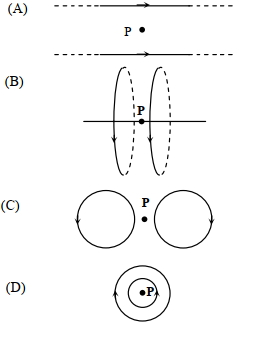
Two wires each carrying a steady current $I$ are shown in four configurations in Column $I$. Some of the resulting effects are described in Column $II$. Match the statements in Column $I$ with the statements in Column $II$ and indicate your answer by darkening appropriate bubbles in the $4 \times 4$ matrix given in the $ORS$.

Column $I$ Column $II$
$(A)$ Point $P$ is situated midway between the wires. $Image$ $(p)$ The magnetic fields $(B)$ at $P$ due to the currents in the wires are in the same direction.
$(B)$ Point $P$ is situated at the mid-point of the line joining the centers of the circular wires, which have same radii. $Image$ $(q)$ The magnetic fields $(B)$ at $P$ due to the currents in the wires are in opposite directions.
$(C)$ Point $P$ is situated at the mid-point of the line joining the centers of the circular wires, which have same radii. $Image$ $(r)$ There is no magnetic field at $P$.
$(D)$ Point $P$ is situated at the common center of the wires. $Image$ $(s)$ The wires repel each other.


A beam of unpolarised light of intensity $I_0$ is passed through a polaroid $A$ and then through another polaroid $B$ which is oriented so that its principal plane makes an angle of $45^o $ relative to that of $A$. The intensity of the emergent light is
The loss in weight of a solid when immersed in a liquid at $0^o C$ is $W_0$ and at $t^o C$ is $W$. If cubical coefficient of expansion of the solid and the liquid by $\gamma_s$ and $\gamma_l$ respectively, then $W$ is equal to :