MCQ
Common name of Benzene-$1, 2$-diol is
  • A
    quinol
  • B
    resorcinol
  • catechol
  • D
    o-cresol

Answer

Correct option: C.
catechol
c
$IUPAC$ name : Benzene-$1,2$-diol

Common name : catechol

Need a full question paper?

Generate a complete, print-ready paper with questions like this in minutes — across 16+ boards, with answer keys.

Start Generating Free

Similar questions

The correct statement$(s)$ about the compound $\mathrm{H}_3 \mathrm{C}(\mathrm{HO}) \mathrm{HC}-\mathrm{CH}=\mathrm{CH}-\mathrm{CH}(\mathrm{OH}) \mathrm{CH}_3(\mathbf{X})$ is(are)

$(A)$ The total number of stereoisomers possible for ${X}$ is $6$

$(B)$ The total number of diastereomers possible for ${X}$ is $3$

$(C)$ If the stereochemistry about the double bond in ${X}$ is trans, the number of enantiomers possible for ${X}$ is $4$

$(D)$ If the stereochemistry about the double bond in ${X}$ is cis, the number of enantiomers possible for ${X}$ is $2$

On passing $ 0.5$  faraday of electricity through $NaCl$, the amount of $Cl$ deposited on cathode is .............. $\mathrm{gm}$
Which of the following nitrogen containing compound does not give Lassaigne's test ?
Which of the following is not correct matched?
Ratio of velocities of ${e^\Theta }$ of hydrogen atom in $1^{st}\,,\, 2^{nd}\,,\, 3^{rd}$ orbit is
For the cell $\mathrm{Cu}(\mathrm{s})\left|\mathrm{Cu}^{2+}(\mathrm{aq})(0.1 \mathrm{M}) \| \mathrm{Ag}^{+}(\mathrm{aq})(0.01 \mathrm{M})\right| \mathrm{Ag}(\mathrm{s})$ the cell potential $\mathrm{E}_{1}=0.3095\, \mathrm{~V}$

For the cell $\mathrm{Cu}(\mathrm{s})\left|\mathrm{Cu}^{2+}(\mathrm{aq})(0.01 \mathrm{M}) \| \mathrm{Ag}^{+}(\mathrm{aq})(0.001 \mathrm{M})\right| \mathrm{Ag}(\mathrm{s})$ the cell potential $=.....\times 10^{-2} \mathrm{~V}$

(Round off to the Nearest Integer).

[Use: $\frac{2.303 \mathrm{RT}}{\mathrm{F}}=0.059$ ]
Number of two electron can have the same values of …… quantum numbers
How many spectral line of Balmer series present in visible region :
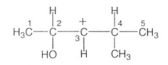
In the following carbocation, $\mathrm{H} / \mathrm{CH}_3$ that is most likely to migrate to the positively charged carbon is
$0.1$ $mole$ of $CH_3NH_2 (K_b = $ $5 \times 10^{-4} $ $)$ is mixed with $0.08 $ $mole$ of $ HCl $ and diluted to one litre. What will be the $H^+ $ concentration in the solution?