MCQ
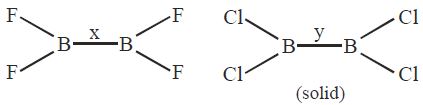
Compare $B—B$ bond length in following molecules :
- A$x > y$
- ✓$y > x$
- C$x = y$
- DNone of these
Fluorine is more electronegative than chlorine. Hence, the electrons of $\mathrm{F}-\mathrm{B}$ bond are more towards $\mathrm{F}$ than the electrons of $\mathrm{Cl}-\mathrm{B}$ bond. Thus, the partial positive charge on $\mathrm{B}$ atom is more in fluoro derivative than in chloro derivative.
Hence, the attraction for the bond pair of electrons of $\mathrm{B}-\mathrm{B}$ bond is greater for the fluoro
compound than for chloro compound.
Hence, $\mathrm{y}>\mathrm{x}$
Generate a complete, print-ready paper with questions like this in minutes — across 16+ boards, with answer keys.
$(a)\,\,B\,\,\,\,\,\,\,\,\,\,(b)\,\,Mg\,\,\,\,\,\,\,\,\,\,\,\,(c)\,\,Li\,\,\,\,\,\,\,\,\,\,\,\,(d)\,\,Al\,\,\,\,\,\,\,\,\,\,\,(e)\,\,K$
$' A ^{\prime} \stackrel{ HNO _3}{\longrightarrow} X ^{\prime} \stackrel{ NaBH _4}{\longrightarrow} \underset{\text { Chiral compound }}{\text { } B ^{}}$ $X$ is $.......$.
$Ni^{2+} | Ni = -0.25\, V$ ;
$Cu^{2+} | Cu = 0.34\, V$
$Ag^+ | Ag = 0.80\, V$ ;
$Zn^{2+} | Zn = -0.76 \,V$
Which of the following reactions under standard condition will not take place in the specified direction