MCQ
Compare carbon-carbon bond rotation energy across $A, B$ and $C$ 
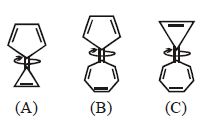
  • A
    $A > B > C$
  • B
    $A > C > B$
  • $B > A > C$
  • D
    $B > C > A$

Answer

Correct option: C.
$B > A > C$
c
Driving force for breaking of double bond is formation of aromatic species.

Order of stability of ring: $6$ -membered $\,>\,5$- membered $\,>\,7$ membered $\,>\,4$- membered $>\, 3$-membered

Hence, $(B)$ will break most easily due to formation of stable rings. $(C)$ will not break easily due to formation of antiaromatic ring.

Need a full question paper?

Generate a complete, print-ready paper with questions like this in minutes — across 16+ boards, with answer keys.

Start Generating Free

Similar questions

Which of the following will show geometrical isomerism
The total number of electrons present in all the $s-$ orbitals, all the $p-$ orbitals and all the $d-$ orbitals of cesium ion are respectively
select correct statement for ideal solution of a non-volatile solute in liquid solvent.
How many of the following metal ions have similar value of spin only magnetic moment in gaseous state? 

(Given: Atomic number: $V , 23 ; Cr , 24 ; Fe , 26;Ni , 28)$

$V ^{3+} \cdot Cr ^{3+}, Fe ^{2+}, Ni ^{3+}$

$K_{sp}$ for $BaSO_4$ at $25\,^oC$ is $1.1 \times 10^{-10}$. To make the new solubility equal to $1.1 \times 10^{-8}$, it is necessary to use the solution of $Na_2SO_4$ of the following concentration....$M$
Correct match among the following are 

$(a) ClO_4^-> ClO_3^-> ClO_2^-> ClO^-$ Stability order

$(b) Cl_2 > Br_2> F_2> I_2$ Bond energy

$(c) OF_2 < OH_2< OCl_2$ Bond angle

$(d) I^-> Br^-> Cl^-$ Reducing power

The mole fraction of water in $20\% $ aqueous solution of ${H_2}{O_2}$ is
$\begin{array}{*{20}{c}}
  {O\,\,\,\,\,\,\,\,\,\,\,\,\,\,\,\,\,\,\,\,\,\,\,\,\,\,\,\,\,\,\,\,\,\,\,\,\,\,\,\,\,\,\,\,\,\,\,\,\,\,\,\,\,\,\,\,\,\,} \\ 
  {||\,\,\,\,\,\,\,\,\,\,\,\,\,\,\,\,\,\,\,\,\,\,\,\,\,\,\,\,\,\,\,\,\,\,\,\,\,\,\,\,\,\,\,\,\,\,\,\,\,\,\,\,\,\,\,\,\,\,\,} \\ 
  {Et - {\text{ }}O - {\text{ }}C - {\text{ }}O - {\text{ }}Et\xrightarrow[{(2){H_3}{O^ \oplus }}]{{\left( 1 \right){\text{ }}C{H_3}MgBr\,\,\left( {excess} \right)}}(A),} 
\end{array}$

 Product $(A)$ is 

Which of the following acid possesses oxidising, reducing and complex forming properties
Which of the following can be detected by carbylamine reaction :