MCQ
Compare relative stability of the following resonating structure.
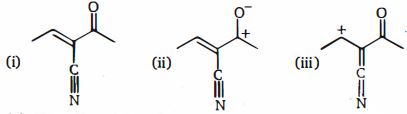
  • $(i) > (ii) > (iii)$
  • B
    $(ii) > (i) > (iii)$
  • C
    $(i) > (iii) > (ii)$
  • D
    $(ii) > (iii) > (i)$

Answer

Correct option: A.
$(i) > (ii) > (iii)$
a
$(a)$ $(1)$ Neutral $R.S.$ are most stable.
$(2)$ With the increase in charge separation stability of $R.S.$ decreases. So  stability order is $I > II > III$

Need a full question paper?

Generate a complete, print-ready paper with questions like this in minutes — across 16+ boards, with answer keys.

Start Generating Free

Similar questions

Which electron transition in a hydrogen atom requires the largest amount of energy :
The neutralization occurs when $10\, mL$ of $0.1 \,M$ acid $'A'$ is allowed to react with $30 \,mL$ of $0.05\, M$ base $M ( OH )_{2}$. The basicity of the acid $'A'$ is $...$ $[ M$ is a metal $]$
In acidic medium, $\mathrm{K}_2 \mathrm{Cr}_2 \mathrm{O}$, shows oxidising action as represented in the half reaction

$\mathrm{Cr}_2 \mathrm{O}_7^{2-}+\mathrm{XH}^{+}+\mathrm{Ye}^{-} \rightarrow 2 \mathrm{~A}+\mathrm{ZH}_2 \mathrm{O}$

$\mathrm{X}, \mathrm{Y}, \mathrm{Z}$ and $\mathrm{A}$ are respectively are:

The vapour density of the methyl ester of an organic monocarboxylic acid is $37$. What is the molecular weight of the acid
Which of the following molecules have non-zero dipole moments ?

$(I)$ gauche conformation of $1, 2$ -dibromoethane

$(II)$ anti conformation of $1, 2$ -dibromoethane

$(III)$ trans- $1, 4$ -dibromocyclohexane

$(IV)$ cis- $1, 4$ -dibromocyclohexane

$(V)$ tetrabromomethane

$(VI)$ $1, 1$ -dibromocyclohexane
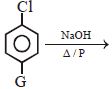
Rate of reaction is maximum if $G$ is
On the basis of the following thermochemical data : $(\Delta _fG^oH^+_{(aq)} = 0)$

$H_2O(l) \rightarrow H^+(aq) + OH^-(aq)\,;\,\,\Delta H = 57.32\,kJ$

$H_2(g)+ \frac{1}{2} O_2(g)  \rightarrow H_2O(l)\,;\,\, \Delta H=-286.20\,kJ$

The value of enthalpy of formation of $OH^-$ ion at $25\,^oC$ is : .............. $\mathrm{kJ}$

If $\Delta H$ is the change in enthalpy and $\Delta E$ the change in internal energy accompanying a gaseous reaction
Correct order of nucleophilicity ?
If the concentration of glucose (C6H12O6) in blood is 0.9g L–1, what will be the molarity of glucose in blood?