Question
Compare the following : $\quad \frac{\sqrt{5}}{3}, \frac{3}{\sqrt{7}}$

Answer

$\begin{array}{ll}\quad & \frac{\sqrt{5}}{3}, \frac{3}{\sqrt{7}} \\ & \sqrt{5} \times \sqrt{7}=\sqrt{35} \\ & 3 \times 3=9=\sqrt{9^2}=\sqrt{81} \\ & \text { Here, } 35<81 \\ \therefore \quad & \sqrt{35}<\sqrt{81} \\ \therefore \quad & \frac{\sqrt{5}}{3}<\frac{3}{\sqrt{7}}\end{array}$

Need a full question paper?

Generate a complete, print-ready paper with questions like this in minutes — across 16+ boards, with answer keys.
Start Generating Free

Similar questions

The following statements are true (T) and which are false (F)?Angles forming a linear pair can both be acute angles.
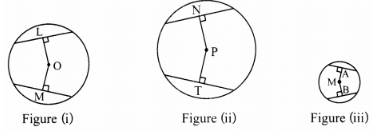
Measure the lengths of the perpendiculars on chords in the following figures.

Image
Did you find OL = OM in fig (i), PN = PT in fig (ii) and MA = MB in fig (iii)?
Write the property which you have noticed from this activity.

The following statements are true (T) and which are false (F)? Give reasons.
Two lines perpendicular to the same line are perpendicular to each other.
The following statements are true (T) and which are false (F):
All the angles of a triangle can be greater than 60°.
Every rhombus is a rectangle,
Answer whether the following statements are true or false? Give reasons in support of your answer.
Every natural number is a whole number.
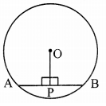
Every student in the group should do this activity. Draw a circle in your notebook. Draw any chord of that circle. Draw perpendicular to the chord through the centre of the circle. Measure the lengths of the two parts of the chord. Group leader should prepare a table as shown below and ask other students to write their observations in it. Write the property which you have observed.

Image

Image

The following statements are true (T) and which are false (F)?
If angles forming a linear pair are equal, then each of these angles is of measure 90°.
$a, b, c, d$ are positive numbers and $\frac{a}{b}=\frac{c}{d}$ is given.$\quad \frac{a}{c}=\frac{b}{d}$
Draw different triangles of different measures and draw in circles and circumcircles of them. Complete the table of observations and discuss.