MCQ
Complete conversion of heat into work by a device, it is not possible. This statement is given :
  • A
    From the zeroth law of thermodynamics
  • B
    From the first law of thermodynamics
  • From the second law of thermodynamics
  • D
    According to Joule's law

Answer

Correct option: C.
From the second law of thermodynamics
C

Need a full question paper?

Generate a complete, print-ready paper with questions like this in minutes — across 16+ boards, with answer keys.
Start Generating Free

Similar questions

What is the value of linear velocity if $\overrightarrow r  = 3\widehat i + 4\widehat j + 6\widehat k$ and $\overrightarrow \omega   = -5\widehat i + 3\widehat j + 5\widehat k$ ?
A Spherical ball of radius $1 mm$ and density $10.5 g / cc$ is dropped in glycerine of coefficient of viscosity $9.8$ poise and density $1.5 g / cc$. Viscous force on the ball when it attains constant velocity is $3696 \times 10^{-x} N$. The value of $x$ is $\text { (Given, } g =9.8 m / s ^2 \text { and } \pi=\frac{22}{7} \text { ) }$
Two particles are projected in air with speed $v_o$ at angles $\theta_1$ and $\theta_2 ($both acute$)$ to the horizontal, respectively. If the height reached by the first particle is greater than that of the second, then tick the right choices
  1. angle of projection: $q_1 > q_2$
  2. time of flight: $T_1 >T_2$
  3. horizontal range: $R_1 > R_2$
  4. total energy: $U_1 > U_2$
How many times is escape velocity $({V_e})$, of orbital velocity $({V_0})$ for a satellite revolving near earth
The position$(x)$ of a particle at any time$(t)$ is given by $x(t) = 4t^3 -3t^2 + 2$ The acceleration and velocity of the particle at any time $t = 2\, sec$ are respectively
Which of the processes described below are irreversible?
With what speed should a body be thrown upwards so that the distances traversed in $5^{\text {th }}$ second and $6^{\text {th }}$ second are equal $..........m/s$
The liquid meniscus in capillary tube will be convex, if the angle of contact is
A point moves such that its displacement as a function of time is given by $x^3$ = $t^3 + 1$. Its acceleration as a function of time $t$ will be
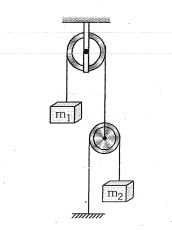
In the system shown in figure pulleys and strings are ideal. Acceleration of $m_1\ w.r.t.\ m_2$ is $(m_1 = 2\ kg\ ; m_2 = 2\ kg)$