Question
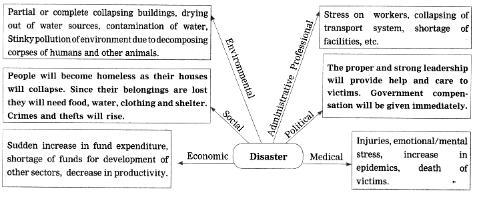
Complete the chart:
Different problems occur with disasters. In the concept map different effects are mentioned. Read it and fill the blank places.
Answer

(Answers are given directly in bold.)
Image

Need a full question paper?

Generate a complete, print-ready paper with questions like this in minutes — across 16+ boards, with answer keys.

Start Generating Free

Similar questions

Where are such sacred groves in Maharashtra? Make a list and visit with your teachers.
The stem of a fruit tree X fixed in soil is cut in a slanting way. The upper part of stem of another fruit tree Y of different variety of same species is also cut in a slanting way. The cut stem of tree Y, without roots but having some leaves, is placed over the rooted cut stem of tree X in such a way that their cut surfaces fit together properly. While joining the two cut stems, care is taken to make sure that the layer Z of one cut stem is in contact with layer Z of the other cut stem. The joint of cut stem is The stem of a fruit tree X fixed in soil is cut in a slanting way. The upper part of stem of another fruit bound tightly with a piece of cloth and covered properly with polythene. Soon the cut heals and the two stems grow together and become one fruit tree producing leaves, flowers and fruits.
  1. What is the name of this method of producing plants or trees?
  2. What name is given to the cut stem of tree X having roots?
  3. What name is given to the cut stem of tree Y which has no roots but has some leaves?
  4. Name the layer Z.
  5. Why should the layer Z of one cut stem be in contact with the layer Z of the other cut stem?
  6. Name any four fruit trees which are usually bred by this technique.
  7. State any one advantage of producing fruit trees by this technique.
An object is placed 10cm from a lens of focal length 5cm. Draw the ray diagrams to show the formation of image if the lens is:
  1. Converging, and
  2. Diverging.
What are macromolecules? Explain Natural and manmade macromolecule.
There are four tiny organisms A, B, C and D. The organism A is a parasitic protozoan which causes a disease known as kala-azar. The organism B is a microscopic single-celled animal which causes malaria disease in human beings. The organism C is a unicellular animal which can change its body shape according to need, it has no fixed shape. The organism D is also a unicellular animal which is slipper-shaped having a large number of tiny hair all around its body.
  1. Name the organisms A, B, C and D.
  2. Name one characteristic body feature of organism A.
  3. Name the insect which carries organism B and transmits it from one person to another.
  4. What name is given to the asexual method of reproduction of (i) organism A, and (ii) organism B?
  5. Where do organisms C and D live?
How does phototropism occur in a plant stem (or shoot)? Explain with the help of labelled diagrams.
Write a short note.
Anomalous behaviour of water
When we touch a hot plate unknowingly, then this heat is sensed by a receptor P present in our fingers. The receptor triggers and impulse in neuron Q which transmits the message to an organ R which is a part of the central nervous system. Here the impulse is passed on to a neuron S which in turn passes it to a yet another neuron T. The neuron T passes the impulse to a tissue U in our arm. The tissue U then contracts and pulls our hand away from the hot plate.
  1. What is the name of (i) receptor P (ii) neuron Q, and (iii) organ R?
  2. What is (i) neuron S, and (ii) neuron T?
  3. Name the tissue U.
  4. What name is given to the phenomenon in which hand is pulled away quickly from the hot plate?
  5. Name the effector in this whole process.
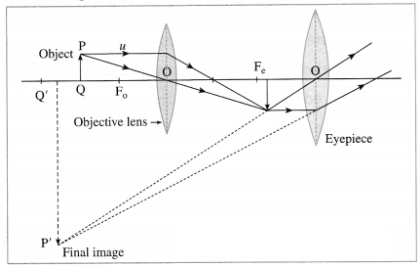
(a) In which type of microscope do you find the lens arrangement as shown in the following diagram?
Image
(b) Write in brief, the working of this microscope.
(c) Where is this microscope used?
Explain asexual reproduction in plants.