Question
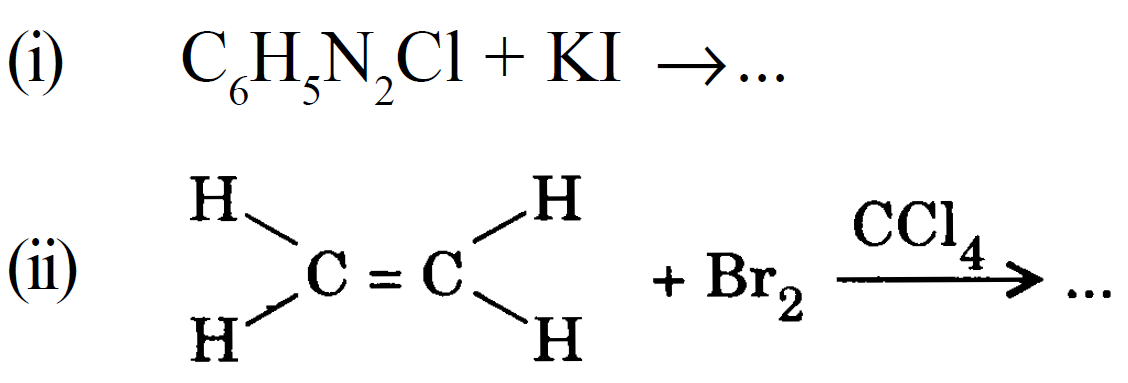
Complete the following reaction equations:

Answer

  1. C6H5N2+Cl- + KI $\rightarrow$ C6H5I + KCl + N2.
  2. CH2 = CH2 + Br2 $\rightarrow$ CH2 (Br) - CH2(Br).

Need a full question paper?

Generate a complete, print-ready paper with questions like this in minutes — across 16+ boards, with answer keys.
Start Generating Free

Similar questions

The vapour pressure of pure benzene at a certain temperature is 0.850 bar. A non-volatile, non-electrolyte solid weighing 0.5 g when added to 39.0 g of benzene (molar mass 78 g mol-1). Vapour pressure of the solution, then, is 0.845 bar. What is the molar mass of the solid substance?
Explain the difference between reucing and non-reducing sugars with examples.
(i) Write the equation for the reaction of $CH _3 I$ with $KNO _2$ and $AgNO _2$.
(ii) Write the Friedel-Crafts reaction to prepare toluene from benzene.
Non-ideal solutions exhibit either positive or negative deviations from Raoult’s law. What are these deviations and why are they caused? Explain with one example for each type.
Explain with chemical reactions, the formation of acyl chlorides from carboxylic acids. ### Write a note on reaction of carboxylic acids with PCI3 PCl5 and SOCI2.
The melting point and boiling point of a substance provides a very information about impurities present in a substance. Explain this statement.
Write the name of the cell which is generally used in inverters. Write the reactions taking place at the anode and the cathode of this cell.
  1. Gas (A) is more soluble in water than Gas (B) at the same temperature. Which one of the two gases will have the higher value of KH (Henry's constant) and why?
  2. In non-ideal solution, what type of deviation shows the formation of maximum boiling azeotropes?
What is lanthanoid contraction? What is its effect on the chemistry of the elements which follow the lanthanoids?
Write short notes :
Diazotisation