Question
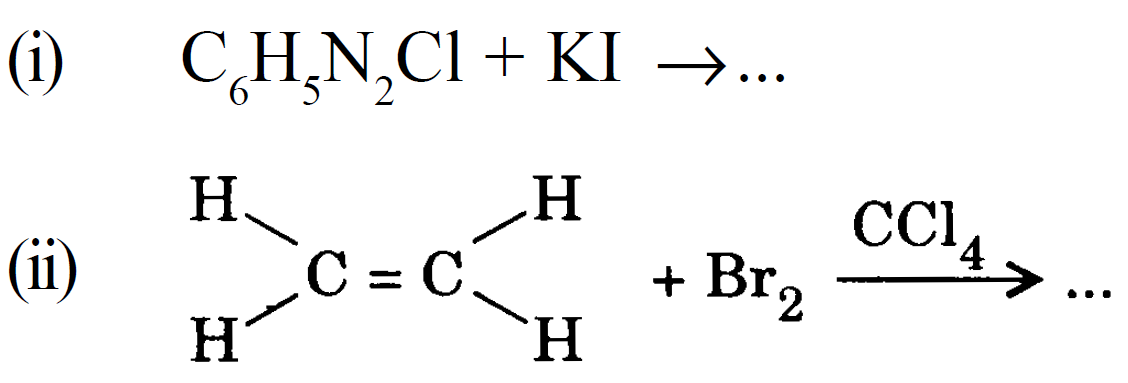
Complete the following reaction equations:
Answer

  1. $C_6H_5N_2^+Cl^- + KI \rightarrow C_6H_5I + KCl + N_2.$
  2. $CH_2 = CH_2 + Br_2 \rightarrow CH_2 (Br) - CH_2(Br).$

Need a full question paper?

Generate a complete, print-ready paper with questions like this in minutes — across 16+ boards, with answer keys.

Start Generating Free

Similar questions

What type of solutions are formed on dissolving different concentrations of soap in water?
Why do gases always tend to be less soluble in liquids as the temperature is raised?
Why does ethylene glycol is mixed with water to be used in car radiator during winter season?
Visha took two aqueous solutions - one containing 7.5g of urea (Molar mass = 60g/ mol) and the other containing 42.75g of substance Z in 100g of water, respectively. It was observed that both the solutions froze at the same temperature. Calculate the molar mass of Z.
Write the reagents used in the following reactions:
  1. $\text{C}_{6}\text{H}_{5}-\text{CO}-\text{CH}_{3}\xrightarrow{\text{ }\ \ \ \ \ \ {?}\ \\ \ \ \ \ \ }\text{C}_{6}\text{H}_{5}-\text{CH}_{2}-\text{CH}_{3}$
  2. $\text{CH}_{3}-\text{COOH}\xrightarrow{\text{ }\ \ \ \ \ \ {?}\ \\ \ \ \ \ \ }\text{CH}_{3}-\text{COCl}$
Note: In the following questions a statement of assertion followed by a statement of reason is given. Choose the correct answer out of the following choices.
Assertion: The total number of atoms present in a simple cubic unit cell is one.
Reason: Simple cubic unit cell has atoms at its corners, each of which is shared between eight adjacent unit cells.
Give the structures of A, B and C in the following reaction:
$\text{C}_6\text{H}_5\text{N}_2\text{Cl}\xrightarrow[]{\text{CuCN}}\text{A}\xrightarrow[]{\text{H}_2\text{O}/\text{H}^+}\text{B}\xrightarrow[\Delta]{\text{NH}_3}\text{C}$
For $M^{2+}/M$ and $M^{3+}/M^{2+}$ systems the values for some metals are as follows:
$Cr^{2+}/Cr$ $- 0.9 V$ $Cr^3/Cr^{2+}$ $- 0.4 V$
$Mn^{2+}/Mn$ $- 1.2 V$ $Mn^{3+}/Mn^{2+}$ $+ 1.5 V$
$Fe^{2+}/Fe$ $- 0.4 V$ $Fe^{3+}/Fe^{2+}$ $+ 0.8 V$
Use this data to comment upon:
  1. The stability of $Fe^{3+}$ in acid solution as compared to that of $Cr^{3+}$ or $Mn^{3+}.$
  2. The ease with which iron can be oxidised as compared to a similar process for either chromium or manganese metal.
What is meant by coagulation of a colloidal solution? Describe briefly any three methods by which coagulation of lyophobic sols can be carried out.
An organic compound $(A) ($molecular formula $C_8H_{16}O_2)$ was hydrolysed with dilute sulphuric acid to give a carboxylic acid $(B)$ and an alcohol $(C).$ Oxidation of $(C)$ with chromic acid produced $(B).\ (C)$ on dehydration gives but-1-ene. Write equations for the reactions involved.