Question
Complete the following table by filling in the blank spaces.
StructureFunction
Yellow Spot
Transfers impulse from inner ear to brain
Helps to change the focal length of the eye lens
Spinal cord
Oval window
Dynamic equilibrium

Answer

StructureFunction
Yellow SpotRegion of the brightest vision
Auditory nerveTransfers impulse from inner ear to brain
Ciliary muscleHelps to change the focal length of the eye lens
Spinal cordConducts impulses
Oval windowSets fluid in cochlear canal into vibration
Semicircular canalsDynamic equilibrium

Need a full question paper?

Generate a complete, print-ready paper with questions like this in minutes — across 16+ boards, with answer keys.

Start Generating Free

Similar questions

State any five functions of the blood.
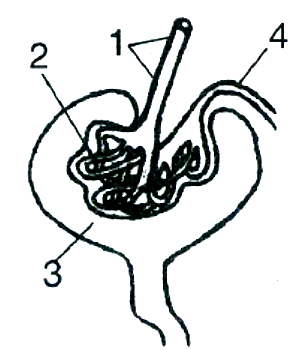
Study the diagram given alongside and then answer the question that follow:

What is the technical term given to the process occurring in 2 and 3? Briefly describe the process.
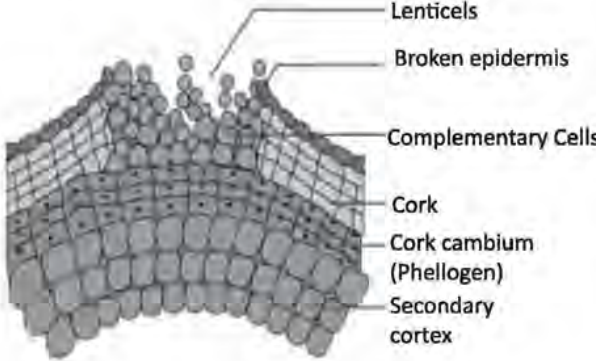
Given below is the diagram showing lenticels. Read the information and fill in the blanks:

Image
Lenticels are specialised structures found in the ____________ (i) ____________ of woody ____________ (ii) ____________ and roots of certain plants. These small, raised patches serve as pores, allow direct ____________ (iii) ____________ exchange between the internal tissues and the atmosphere. Unlike the impermeable bark, lenticels facilitate the movement oxygen, ____________ (iv) ____________ , and water vapour. They are essential for the survival and growth of ____________ (v) ____________ plants.
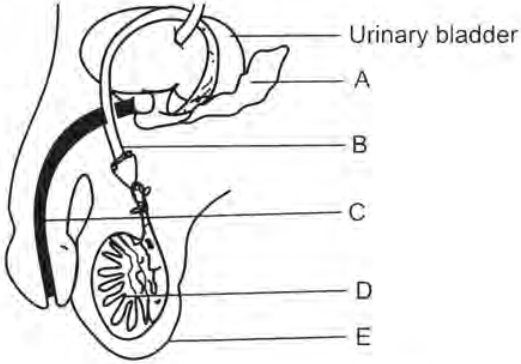
The diagram given below represents a surgical sterilisation method in males. Study the same and answer the questions that follow :

Image
(i) Give the name of the surgical method represented in the diagram.
(ii) Which part is ligated or cut?
(iii) Name the corresponding surgical method conducted on females.
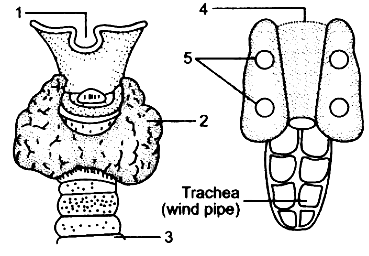
Given alongside are the diagrammatic sketches of some endocrine glands. Observe the figures and answer the following questions:
(i) Label the parts numbered 1 to 5.
(ii) Name the hormones secreted by (2) and (5).
(iii) Which chemicals in our body are greatly affected by hormones?
(iv) What is the chemical nature of hormones?
(v) Name the elements related to the functioning of hormones secreted by the structure (2) and (5).
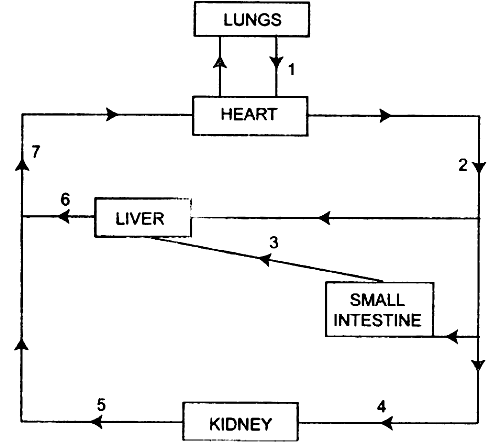
Given below is the simplified pathway of the circulatory system:

(i) Name the blood vessels marked 1 to 8.
(ii) Name the chamber of the heart which:
(a) Receives blood from ‘1’.
(b) Pumps blood into blood vessel ‘8’.
(iii) Mention two structural differences between blood vessels ‘7’ and ‘2’.
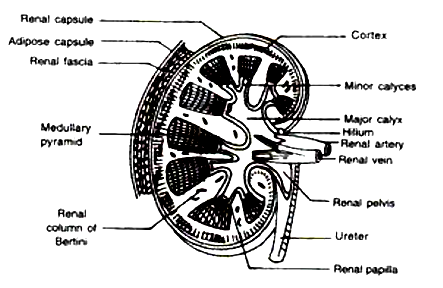
Given below is a diagram of a human kidney, cut open longitudinally. Answer the following:

(i) Give definition of excretion.
(ii) Name the unit of kidney.
(iii) Why does the cortex of kidney show dotted appearance?
(iv) List the functions of the kidney.
Match the terms in Column I with those in Column II and write down the matching pairs
Column I Column II
aBowman's Capsule Renal artery
bContains more CO2 and less urea Regulates amount of water excreted
cAnti-diuretic hormone Renal Vein
dContains more urea Glomerulus
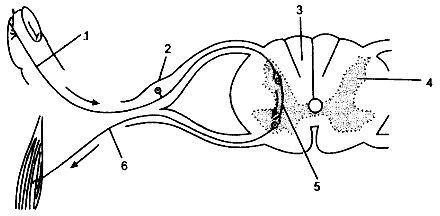
The diagram given below is a representation of a certain phenomenon pertaining to the nervous system. Study the diagram and answer the following questions:

(i) Name the phenomenon which is being depicted.
(ii) Give the technical term for the point of contact between the two nerve cells.
(iii) Name the parts 1, 2, 3, and 4.
(iv) Write the functions of parts 5 and 6
(v) How does the arrangement of neurons in the spinal cord differ from that of the brain?