Question
Complete the following table:
Car Model
Driver $X$
Reaction time $0.20s$
Driver $Y$
Reaction time $0.30s$
$A\ ($deceleration on hard braking $= 6.0\ m/s^2)$
Speed $= 54\ km/h$
Braking distance
$a = ...$
Total stopping distance
$b = ...$
Speed $= 72\ km/h$
Braking distance
$c = ...$
Total stopping distance
$d = ...$
$B\ ($deceleration on hard braking $= 7.5\ m/s^2)$
Speed $= 54\ km/h$
Breaking distance
$e = ...$
Total stopping distance
$f = ...$
Speed $72\ km/h$
Braking distance
$g = ...$
Total stopping distance
$h = ...$

Answer

Car Model
Driver $X$
Reaction time $0.25s$
Driver $Y$
Reaction time $0.35s$
$A\ ($deceleration on hard braking $= 6.0\ m/s^2)$
Speed $= 54\ km/h$
Braking distance
a = 19m
Total stopping distance
$b = 22m$
Speed $= 72\ km/h$
Braking distance
$c = 33m$
Total stopping distance
$d = 39m$
$B\ ($deceleration on hard braking $= 7.5\ m/s^2)$
Speed $= 54\ km/h$
Breaking distance
$e = 15m$
Total stopping distance
$f = 18m$
Speed $72\ km/h$
Braking distance
$g = 27m$
Total stopping distance
$h = 33m$
$\text{a}=\frac{0^2-15^2}{2(-6)}=19\text{m}$
So$, b = 0.2 \times 15 + 19 = 33m$
Similarly other can be calculated.
Braking distance : Distance travelled when brakes are applied.
Total stopping distance $=$ Braking distance $+$ distance travelled in reaction time.

Need a full question paper?

Generate a complete, print-ready paper with questions like this in minutes — across 16+ boards, with answer keys.

Start Generating Free

Similar questions

Suppose you are inside the water in a swimming pool near an edge. A friend is standing on the edge. Do you find your friend taller or shorter than his usual height?
(a) An electron is revolving with a speed of 2 $\times 10^5 m / s$ in the orbit of radius $0.51 A$ in a hydrogen atom. Calculate the magnetic moment of the electron.
(b) Equivalent electric current due to orbital speed of electron.
(c) Magnetic field generated at the centre of the nucleus.
Light of frequency $7.21 \times 10^{14}$ Hz is incident on a metal surface. Electrons with a maximum speed of $6.0 \times 10^5$ m / s are ejected from the surface. What is the threshold frequency for photo-emission of electrons?
A long bar magnet has a pole strength of 10A-m. Find the magnetic field at a point on the axis of the magnet at a distance of 5cm from the north pole of the magnet.
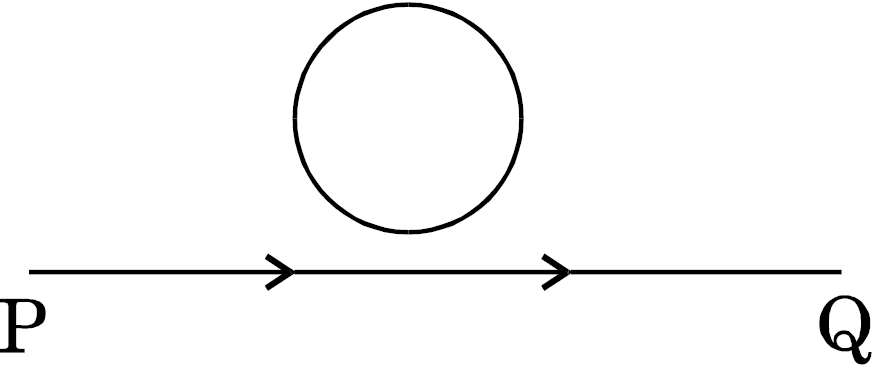
A conducting loop is held above a current carrying wire ‘PQ’ as shown in the figure. Depict the direction of the current induced in the loop when the current in the wire PQ is constantly increasing.
Some washing machines have cloth driers. It contains a drum in which wet clothes are kept. As the drum rotates, the water particles get separated from the cloth. The general description of this action is that "the centrifugal force throws the water particles away from the drum". Comment on this statement from the viewpoint of an observer rotating with the drum and the observer who is washing the clothes.
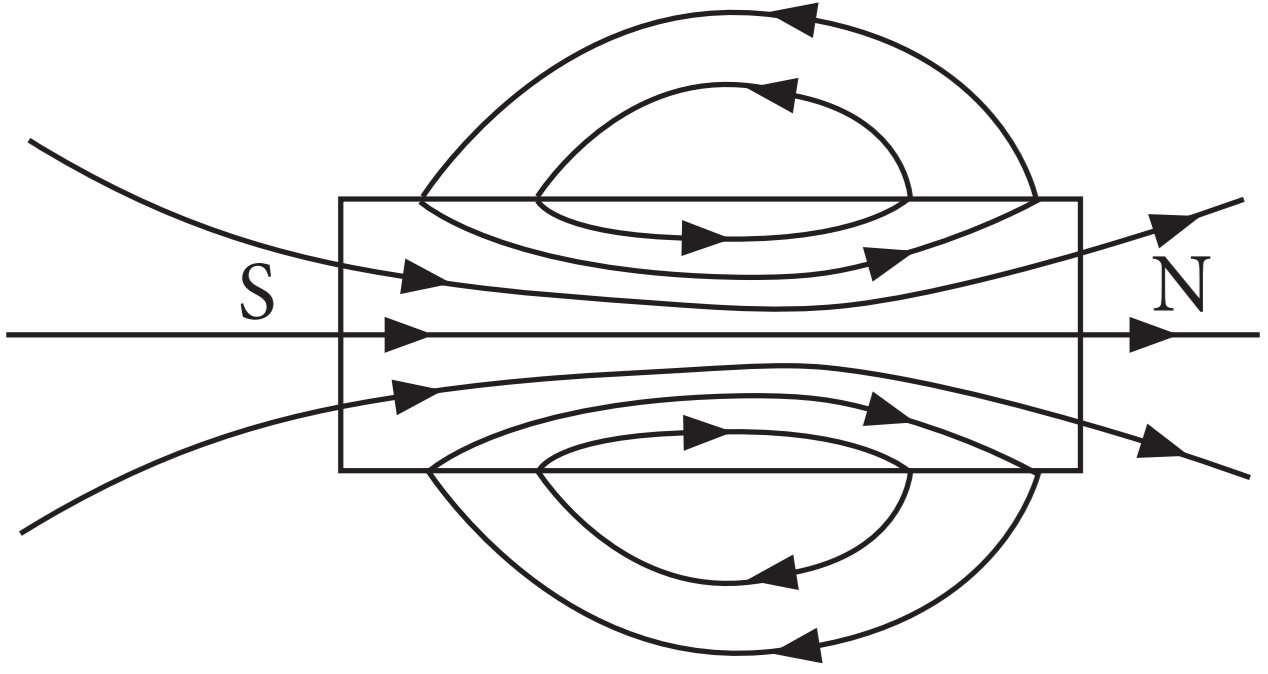
By analogy to Gauss's law of electrostatics, we can write Gauss's law of magnetism as $\oint\vec{\text{B}}.\text{d}\vec{\text{v}}=\mu_0\text{m}_{\text{inside}}$ where $\oint\vec{\text{B}}.\text{d}\vec{\text{s}}$ is the magnetic flux and $\text{m}_{\text{inside}}$ is the net pole strength inside the closed surface. We do not have an isolated magnetic pole in nature. At least none has been found to exist till date. The smallest unit of the source of magnetic field is a magnetic dipole where the net magnetic pole is zero. Hence, the net magnetic pole enclosed by any closed surface is always zero. Correspondingly, the flux of the magnetic field through any closed surface is zero. 
  1. Consider the two idealised systems
  1. a parallel plate capacitor with large plates and small separation and
  2. a long solenoid of length L >> R, radius of cross-section.
(In) (i) $\vec{\text{E}}$ is ideally treated as a constant between plates and zero outside. In (ii) Magnetic field is constant inside the solenoid and zero outside. These idealised assumptions, however, contradict fundamental laws as below
  1. Case (i) contradicts Gauss's law for electrostatic fields.
  2. Case (ii) contradicts Gauss's law for magnetic fields.
  3. Case (i) agrees with $\oint\vec{\text{E}}.\text{d}\vec{\text{l}}=0$
  4. Case (ii) contradicts $\oint\vec{\text{H}}.\text{d}\vec{\text{l}}=\text{l}_{\text{en}}.$ 
  1. The angle between the true geographic north and the north shown by a compass needle is called as:
  1. $\text{Zero}$
  2. $\frac{\mu_0}{4\pi}$
  3. $4\pi\mu_0$
  4. $\frac{4\mu_0}{\pi}$
  1. A closed surface S encloses a magnetic dipole of magnetic moment 2ml. The magnetic flux emerging from the surface is:
  1. $\mu_0\text{m}$
  2. $\text{Zero}$
  3. $2\mu_0\text{m}$
  4. $\frac{2\text{m}}{\mu _0}$
  1. Which of the following is not a consequence of Gauss's law?
  1. The magnetic poles always exist as unlike pairs of equal strength.
  2. If several magnetic lines of force enter in a closed surface, then an equal number of lines of force must leave that surface.
  3. There are abundant sources or sinks of the magnetic field inside a closed surface.
  4. Isolated magnetic poles do not exist.
  1. The surface integral of a magnetic field over a surface:
  1. Is proportional to mass enclosed.
  2. Is proportional to charge enclosed.
  3. S zero.
  4. Equal to its magnetic flux through that surface.
In a chamber, a uniform magnetic field of 6.5 G (1 G = 10-4T ) is maintained. An electron is shot into the field with a speed of 4.8 X 10⁶ m s-1normal to the field. Explain why the path of the electron is a circle. Determine the radius of the circular orbit.
$\left( e =1.6 \times 10^{-19} C , m_e=9.1 \times 10^{-31} kg\right)$
A small object is embedded in a glass sphere $(\mu=1.5)$ of radius 5.0cm at a distance 1.5cm left to the centre. Locate the image of the object as seen by an observer standing.
  1. To the left of the sphere.
  2. To the right of the sphere.
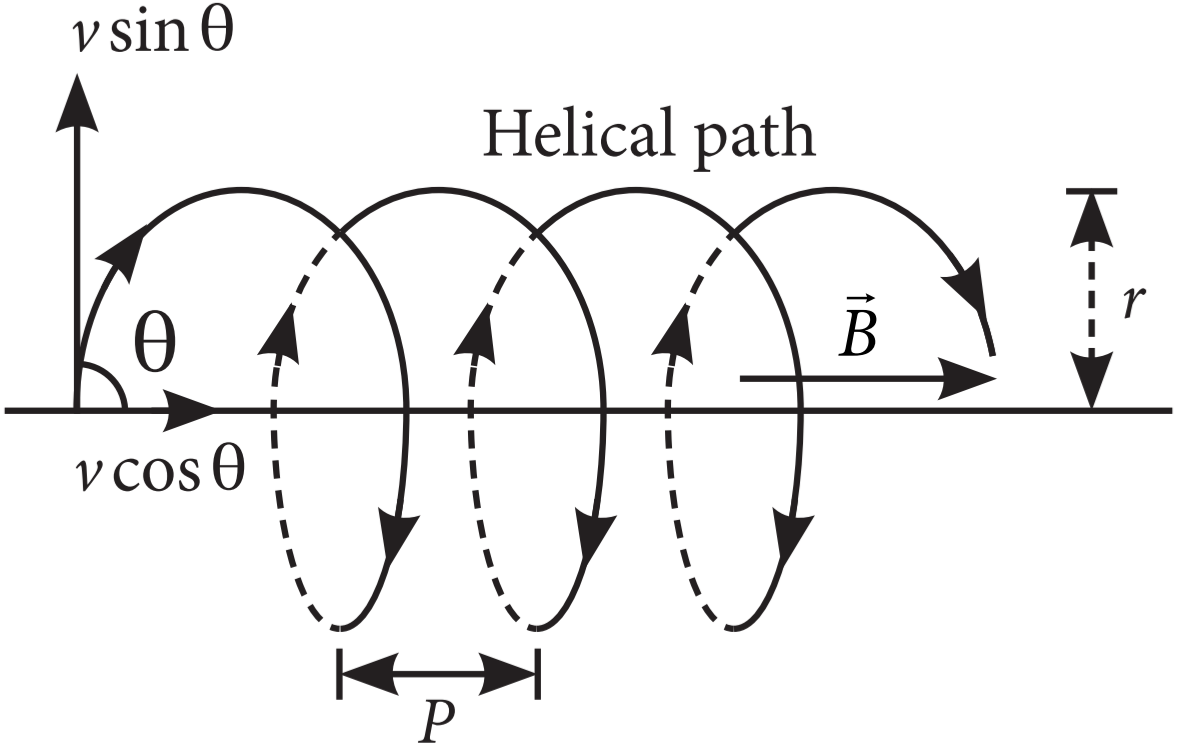
The path of a charged particle in magnetic field depends upon angle between velocity and magnetic field. If velocity $\vec{\text{v}}$ is at angle $\theta$ to $\vec{\text{B}},$ component of velocity parallel to magnetic field $(\text{v}\cos\theta)$ remains constant and component of velocity perpendicular to magnetic field $(\text{v}\sin\theta)$ is responsible for circular motion, thus the charge particle moves in a helical path.
The plane of the circle is perpendicular to the magnetic field and the axis of the helix is parallel to the magnetic field. The charged particle moves along helical path touching the line parallel to the magnetic field passing through the starting point after each rotation. Radius of circular path is $\text{r}=\frac{\text{mv}\sin\theta}{\text{qB}}$ Hence the resultant path of the charged particle will be a helix, with its axis along the direction of $\vec{\text{B}}$ as shown in figure.
  1. When a positively charged particle enters into a uniform magnetic field with uniform velocity, its trajectory can $b$:
  1. A straight line.
  2. A circle.
  3. A helix.
  1. $(i)$ Only
  2. $(i)$ or $(ii)$
  3. $(i)$ or $(iii)$
  4. Any one of $(i), (ii)$ and $(iii)$
  1. Two charged particles $A$ and $B$ having the same charge, mass and speed enter into a magnetic field in such a way that the initial path of $A$ makes an angle of $30^\circ$ and that of $B$ makes an angle of $90^\circ$ with the field. Then the trajectory of:
  1. B will have smaller radius of curvature than that of $A$.
  2. Both will have the same curvature.
  3. A will have smaller radius of curvature than that of $B.$
  4. Both will move along the direction of their original velocities.
  1. An electron having momentum $2.4 \times 10^{-23}kg m/ s$ enters a region of uniform magnetic field of $0.15T.$ The field vector makes an angle of $30^\circ$ with the initial velocity vector of the electron. The radius of the helical path of the electron in the field shall be:
  1. $mm$
  2. $1\ mm$
  3. $\frac{\sqrt{3}}{2}\text{ mm}$
  4. $0.5\ mm$
  1. The magnetic field in a certain region of space is given by $\vec{\text{B}}=8.35\times10^{-2}\hat{\text{i}}\text{T}.$ A proton is shot into the field with velocity $\vec{\text{v}}=(2\times10\hat{\text{i}}+4\times10^5\hat{\text{j}.}$ The proton follows a helical path in the field. The distance moved by proton in the $x-$ direction during the period ofone revolution in the $yz-$ plane will be:
$($Mass of proton $= 1.67 \times 10^{-27}kg)$
  1. $0.053m$
  2. $0.136m$
  3. $0.157m$
  4. $0.236m$
  1. The frequency of revolution of the particle is:
  1. $\frac{\text{m}}{\text{pB}}$
  2. $\frac{\text{qB}}{2\pi\text{m}}$
  3. $\frac{2\pi\text{R}}{\text{v}\cos\theta}$
  4. $\frac{2\pi\text{R}}{\text{v}\sin\theta}$