Question
Complete the following table:
Car Model
Driver X
Reaction time 0.20s
Driver Y
Reaction time 0.30s
A (deceleration on hard braking = 6.0m/s2)
Speed = 54km/h
Braking distance
a = ...
Total stopping distance
b = ...
Speed = 72km/h
Braking distance
c = ...
Total stopping distance
d = ...
B (deceleration on hard braking = 7.5m/s2)
Speed = 54km/h
Breaking distance
e = ...
Total stopping distance
f = ...
Speed 72km/h
Braking distance
g = ...
Total stopping distance
h = ...

Answer

Car Model
Driver X
Reaction time 0.25s
Driver Y
Reaction time 0.35s
A (deceleration on hard braking = 6.0m/s2)
Speed = 54km/h
Braking distance
a = 19m
Total stopping distance
b = 22m
Speed = 72km/h
Braking distance
c = 33m
Total stopping distance
d = 39m
B (deceleration on hard braking = 7.5m/s2)
Speed = 54km/h
Breaking distance
e = 15m
Total stopping distance
f = 18m
Speed 72km/h
Braking distance
g = 27m
Total stopping distance
h = 33m

$\text{a}=\frac{0^2-15^2}{2(-6)}=19\text{m}$

So, b = 0.2 × 15 + 19 = 33m

Similarly other can be calculated.

Braking distance: Distance travelled when brakes are applied.

Total stopping distance = Braking distance + distance travelled in reaction time.

Need a full question paper?

Generate a complete, print-ready paper with questions like this in minutes — across 16+ boards, with answer keys.

Start Generating Free

Similar questions

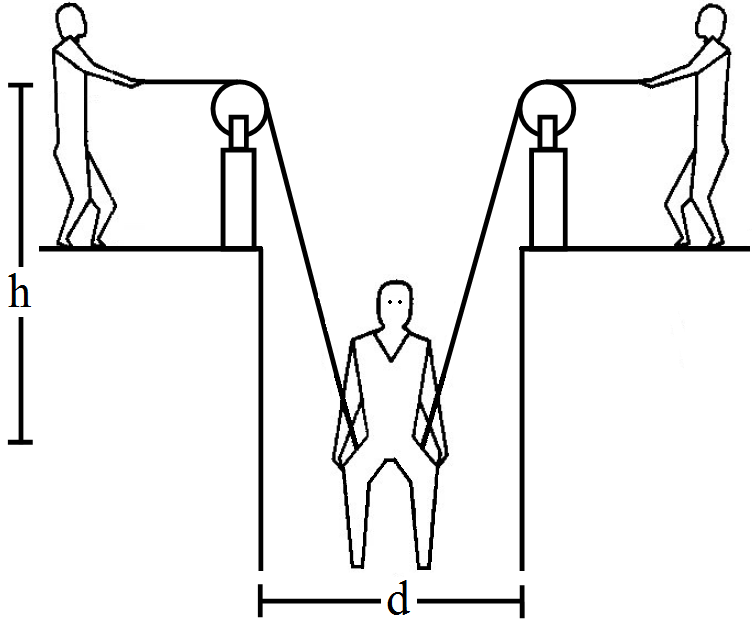
A man has fallen into a ditch of width d and two of his friends are slowly pulling him out using a light rope and two fixed pulleys as shown in figure. Show that the force (assumed equal for both the friends) exerted by each friend on the road increases as the man moves up. Find the force when the man is at a depth h.

Two point charges $+3 \mu C$ and $-3 \mu C$ are kept at a distance of 20 cm from each other in vacuum. (i) What will be the electric field at the mid-point of the line joining the two charges? (ii) If a charge of $1.5 \times 10^{-9} C$ is placed at this mid-point, then how much force will be applied on this charge?
The combination of two bar magnets makes 10 oscillations per second in an oscillation magnetometer when like poles are tied together and 2 oscillations per second when unlike poles are tied together. Find the ratio of the magnetic moments of the magnets. Neglect any induced magnetism.
The number of free electrons in a unit volume copper conductor estimated in Example 8.1 is 8.5 x 1028 per m3.How long does an electron take to drift from one end of a wire 3.0 m long to its other end? The area of cross-section of the wire is 2.0 x 10⁻⁶ m2and it is carrying a current of 3.0 A.
In how many bands the full range of radiowaves can be divided ? Describe about all the bands in brief.
When a ferromagnetic material goes through a hysteresis loop, its thermal energy is increased. Where does this energy come from?
A closed bottle contains some liquid. The bottle is shaken vigorously for 5 minutes. It is found that the temperature of the liquid is increased. Is heat transferred to the liquid? Is work done on the liquid? Neglect expansion on heating.
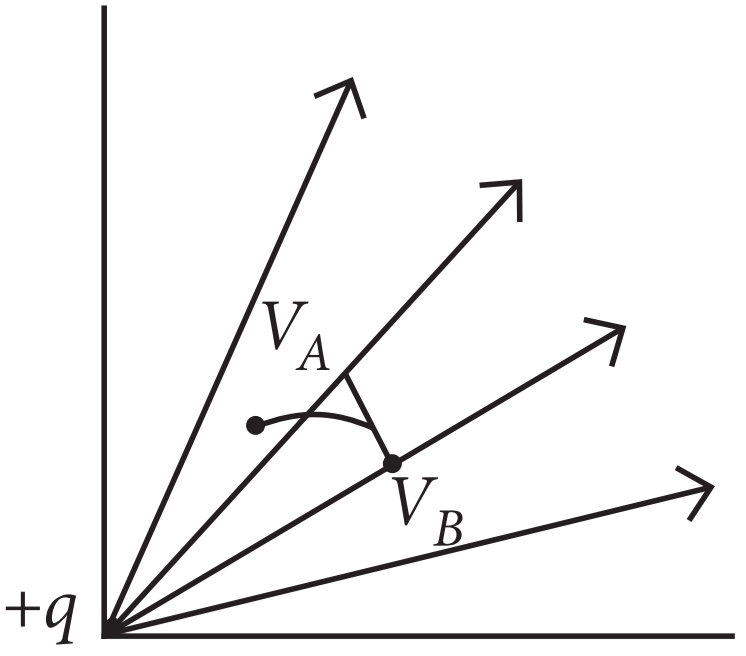
Electrostatic potential energy of a system of point charges is defined as the total amount of work done in bringing the different charges to their respective positions from infinitely charge mutual separations. The work is stored in the system of two point charges in the form of electrostatic potential energy U of the system. Electric potential difference between any points A and B in an electric field is the amount of work done in moving a unit positive test charge from A to B along any path agents the electrostatic force $\text{V}_\text{B}-\text{V}_\text{A}=\frac{\text{W}_\text{AB}}{\text{q}_\text{o}}=\int\vec{\text{E}}.\text{dl}.$

  1. A test charge is moved from lower potential point to a higher potential point. The potential energy of test charge wiII.
  1. Remain the same.
  2. Increase.
  3. Decrease.
  4. Become zero.
  1. Which of the following statement is not true?
  1. Electrostatic force is a conservative force.
  2. Potential energy of charge q at a point is the work done per unit charge in bringing a charge from any point to infinity.
  3. Spring force and gravitational force are conservative force.
  4. Both (a) and (c).
  1. Work done in moving a charge from one point to another inside a uniformly charged conducting sphere is:
  1. Always zero.
  2. Non-zero.
  3. May be zero.
  4. None of these.
  1. The work done in bringing a unit positive charge from infinite distance to a point at distance x from a positive charge Q is W. Then the potential $\phi$ at that point is:
  1. $\frac{\text{WQ}}{\text{x}}$

  2. W

  3. $\frac{\text{W}}{\text{x}}$

  4. WQ

  1. If $1\mu\text{C}$ charge is shifted from A to B and it is found that work done by an external force is $40\mu\text{J}.$ ln doing so against electrostatics force, the potential difference VA - VB is:
  1. 40V
  2. -40V
  3. 20V
  4. -60V
When a ferromagnetic material goes through a hysteresis loop, its thermal energy is increased. Where does this energy come from?
An electric dipole of length 2 cm is placed in an electric field of intensity $10^5$ Newton/Coulomb in such a way that its axis makes an angle of $30^{\circ}$ with the direction of the field. A torque of $10 \sqrt{3}$ Newton meter acts on it. Find the magnitude of charge on the electric diple.