Question
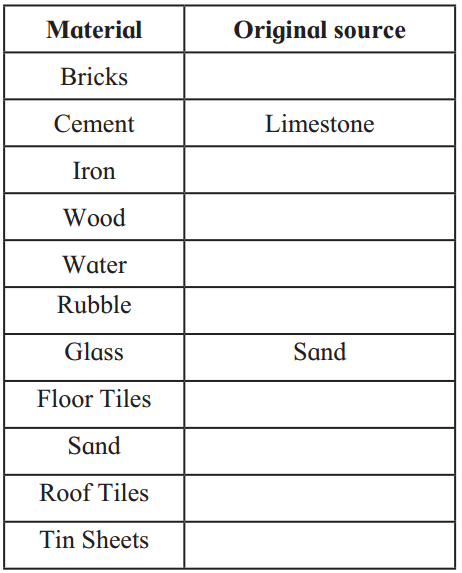
Complete the table given below regarding the original source.
Get the step-by-step solution for this question inside the Vidyadip app.
Get the answer in the appGenerate a complete, print-ready paper with questions like this in minutes — across 16+ boards, with answer keys.
| Column ‘A’ | Column ‘B’ |
| 1. Fats | (a) Jowar |
| 2. Proteins | (b) Oil |
| 3. Vitamins | (c) Bran of cereals |
| 4. Minerals | (d) Pulses |
| 5. Starchy foods | (e) Iron |
| Column ‘A’ | Column ‘B’ |
| 1. Charles Darwin | a. a gradual and continuous change |
| 2. Evolution | b. means ‘terrible lizard’ |
| 3. Dinosaur | c. gradually evolved into plants and animals |
| 4. Multicellular | d. explained the concept of evolution |
| 5. Invertebrates | e. frogs |
| 6. Aquatic | f. snake |
| 7. Amphibians | g. cow |
| 8. Reptiles | h. snails |
| 9. Mammals | i. fish |
| Group ‘A’ | Group ‘B’ |
| (a) Ringworm | 1. Contaminated Air |
| (b) Jaundice | 2. Direct contact |
| (c) Tuberculosis | 3. Open wound contaminated with soil |
| (d) Dengue | 4. Contaminated food and water |
| (e) Tetanus | 5. Mosquito bite |
| ‘A’ | ‘B’ |
| 1. Karanj | (a) Traffic accidents |
| 2. LPG | (b) Noise |
| 3. Headaches | (c) Local variety |
| 4. Deaths | (d) Fuel |
| Column ‘A’ | Column ‘B’ |
| 1. Vardhaman Mahavir | a. 563BC-483BC |
| 2. Sunrise to sunset | b. Smallest unit of time |
| 3. Gautam Buddha | c. Day |
| 4. Sunset to sunrise | d. One year |
| 5. Second | e. 599BC-527BC |
| 6. 100 years | f. Night |
| 7. 12 months | g. A year |
| 8. 1000 years | h. A week |
| 9. Seven days | i. A century |
| 10. Two weeks | j. A fortnight |
| 11. Christian Era | k. A millennium |
| 12. Rajyabhishek Shaka | l. Prophet Muhammad |
| 13. Hijri Era | m. Jesus Christ |
| 14. Shahenshahi Era | n. Parsi Community |
| 15. Parsi Community | o. Chhatrapati Shivaji |
| 16. Indian’s Era | p. Hijri Era |
| 17. Muhammad migrate | q. Shahenshahi Era |
| r. Rajyabhishek Shaka | |
| s. Vikram Samvat |
| Column ‘A’ | Column ‘B’ |
| 1. Constituent of food giving energy | (a) Iron |
| 2. Costituent of food needed for repair | (b) Vitamins |
| 3. Constituent of food proetcting internal organs | (c) Proteins |
| 4. Constituents of food helping in resisting diseases | (d) Carbohydrates |
| 5. Constituent of food necessary to supply enough oxygen | (e) Fats |
| Column ‘A’ | Column ‘B’ |
| 1. Fossil of a human skull | a. Along the Ganga river in South India |
| 2. Fossil of a child’s skull | b. Afghanistan and Sri Lanka |
| 3. New Stone Age site in India | c. Hoshangabad in Madhya Pradesh |
| 4. Remains of Old Stone Age | d. Patane in Jalgaon district in Maharashtra |
| 5. Site of Middle Stone Age | e. A village near Puducherry |
| 6. Knife and sickle | f. Homo erectus |
| 7. Antlers used as hammer | g. Homo sapiens |
| 8. Choppers and scrappers | h. Mesolithic Age |
| 9. Domesticated animals | i. Old Stone Age man |
| Group ‘A’ | Group ‘B’ |
| 1. Mouth | (a) Excess water present is absorbed |
| 2. Stomach | (b) Faeces collected |
| 3. Small intestine | (c) Formation of bolus |
| 4. Large intestine | (d) Food absorbed into the blood |
| 5. Rectum | (e) Food changes to thin slurry |
‘A’ | ‘B’ |
(1) Rakesh Sharma went to space | (a) 2008 |
(2) Chandrayaan I launched | (b) 2014 |
(3) MOM launched in space | (c) 1984 |
(4) MOM established in an orbit | (d) 2013 |
| Group ‘A’ | Group ’B’ |
| 1. Lungs | (a) Circulation |
| 2. Stomach | (b) Respiration |
| 3. Heart | (c) Co-ordination |
| 4. Brain | (d) Digestion |