MCQ
Complex compound $[Co(SCN)_2(NH_3)_4]Cl$ does not exhibit
- AIonisation isomerism
- BGeometrical isomerism
- CLinkage isomerism
- ✓Optical isomerism
Generate a complete, print-ready paper with questions like this in minutes — across 16+ boards, with answer keys.
| $I.E.\, (kJ \,mol^{-1})$ | $I.E.\, (kJ\, mol^{-1})$ |
| $A_{(g)} \to A^+_{(g)}+e^-,$ $A_1$ | $B_{(g)} \to B^{+}_{(g)}+e^-,$ $B_1$ |
| $B^+_{(g)} \to B^{2+}_{(g)}+e^-,$ $B_2$ | $C_{(g)} \to C^{+}_{(g)}+e^-,$ $C_1$ |
| $C^+_{(g)} \to C^{2+}_{(g)}+e^-,$ $C_2$ | $C^{2+}_{(g)} \to C^{3+}_{(g)}+e^-,$ $C_3$ |
If monovalent positive ion of $A,$ divalent positive ion of $B$ and trivalent positive ion of $C$ have zero electron. Then incorrect order of corresponding $I.E.$ is
| gas | $Ar$ | $Ne$ | $Kr$ | $Xe$ |
| $a /\left( atm \,dm ^{6} \,mol ^{-2}\right)$ | $1.3$ | $0.2$ | $5.1$ | $4.1$ |
| $b /\left(10^{-2} \,dm ^{3}\, mol ^{-1}\right)$ | $3.2$ | $1.7$ | $1.0$ | $5.0$ |
Which gas is expected to have the highest critical temperature?
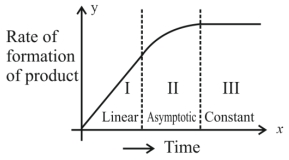
$(A)$ Over all order of this reaction is one
$(B)$ Order of this reaction can't be determined
$(C)$ In region$-I$ and $III$, the reaction is of first and zero order respectively
$(D)$ In region$-II$, the reaction is of first order
$(E)$ In region$-II$, the order of reaction is in the range of $0.1$ to $0.9$.