MCQ
Complexes given below show
  • A
    Optical isomerism
  • B
    Coordinate isomerism
  • Geometrical isomerism
  • D
    Bridge isomerism

Answer

Correct option: C.
Geometrical isomerism
c
The complexes exhibit geometrical isomerism.One one isomer, two chlorine atoms are present on the same side of the ring .It is cis isomer.In the other isomer, they are on the opposite side of the ring.It is trans isomer.

Need a full question paper?

Generate a complete, print-ready paper with questions like this in minutes — across 16+ boards, with answer keys.

Start Generating Free

Similar questions

Which one is incorrect :
Find out the major product for the following reaction.
When m -chlorobenzaldehyde is treated with $50 \% KOH$ solution, the product(s) obtained is (are):
The molar conductivities $\Lambda _{NaOH}^o$ and $\Lambda _{HCl}^o$ at infinite dilution in water at $25^o C$ are $91.0$ and $426.2\, S \,cm^2/mol$ respectively. To calculate $\Lambda _{HOAc}^o,$ the additional value required is
Which of the following statement is correct with respect to the property of elements with an increase in atomic number in the carbon family (group $14$)
The first ionization enthalpy of $Na , Mg$ and $Si$, respectively, are: $496,737$ and $786\; kJ\; mol ^{-1}$. The first ionization enthalpy $( kJ\; mol ^{-1})$ of $Al$ is
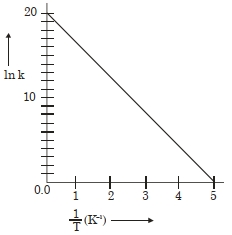
For a reaction, given below is the graph of $\ln k\,v s \frac{1}{ T }$. The activation energy for the reaction is equal to $......cal$ $mol ^{-1}$. (Nearest integer). (Given : $R =2\,cal\,K ^{-1}\,mol ^{-1}$ )
$IUPAC $ name of the following compound will be

$\begin{array}{*{20}{c}}
  {C{H_3} - CH = C - C{H_2} - C{H_3}} \\ 
  {|\,\,} \\ 
  {\,\,\,\,\,\,\,\,\,\,\,\,\,\,\,\,\,\,\,\,\,\,\,\,\,\,\,\,\,\,\,\,\,\,\,\,C{H_2} - C{H_2} - C{H_3}} 
\end{array}$

Pure $PCl_5$ is introduced into an evacuated chamber and comes to equilibrium at $247\,^oC$ and $2.0\  atm$. The equilibrium gaseous mixture contains $40\%$ chlorine by volume Calculate $K_p$ at $247\,^oC$ for the reaction $PCl_5(g) \rightleftharpoons  PCl_3(g) + Cl_2(g)$ .....$atm$
The reagent, from the following, which converts benzoic acid to benzaldehyde in one step is