MCQ
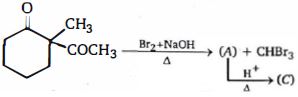
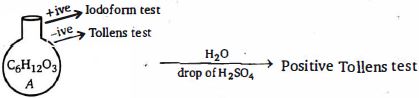
Compound $(A)$ is
  • A
    $\begin{matrix}
       O\,\,\,\,\,\,\,\,\,\,\,\,\,\,\,  \\
       ||\,\,\,\,\,\,\,\,\,\,\,\,\,\,\,\,  \\
       C{{H}_{3}}-C-CH-C{{H}_{2}}  \\
      \,\,\,\, \,\,\,\,\,\,\,\,\,\,\,\,\,\,\,\,\,\,\,\,|\,\,\,\,\,\,\,\,\,\,\,\,\,\,\,\,\,|  \\
      \,\,\,\, \,\,\,\,\,\,\,\,\,\,\,\,\,\,\,\,\,\,\,\,\,\,\,\,\,\,OC{{H}_{3}}\,OC{{H}_{3}}  \\
    \end{matrix}$
  • B
    $\begin{matrix}
      \,\, \,\,\,\,\,\,\,\,\,\,\,O\,\,\,\,\,\,\,OC{{H}_{3}}\,  \\
       ||\,\,\,\,\,\,\,\,|  \\
       C{{H}_{3}}-C-C-C{{H}_{3}}  \\
      \,\, \,\,\,\,\,\,\,\,\,\,|  \\
      \,\,\,\, \,\,\,\,\,\,\,\,\,\,\,\,\,\,\,\,\,OC{{H}_{3}}  \\
    \end{matrix}$
  • $\begin{matrix}
       O\,\,\,\,\,\,\,\,\,\,\,\,\,\,\,\,\,\,\,\,\,\,\,\,\,\,\,\,\,\,\,\,\,\,\,\,\,\,  \\
       ||\,\,\,\,\,\,\,\,\,\,\,\,\,\,\,\,\,\,\,\,\,\,\,\,\,\,\,\,\,\,\,\,\,\,\,\,\,\,  \\
       C{{H}_{3}}-C-C{{H}_{2}}-CH-OC{{H}_{3}}  \\
       \,\,\,\,\,\,\,\,\,\,\,\,\,\,\,\,\,\,\,\,\,\,\,|\,\,  \\
       \,\,\,\,\,\,\,\,\,\,\,\,\,\,\,\,\,\,\,\,\,\,\,\,\,\,\,\,\,\,\,\,OC{{H}_{3}}  \\
    \end{matrix}$
  • D
    $\begin{matrix}
       O\,\,\,\,\,\,\,\,\,\,\,\,\,\,\,\,\,\,\,\,\,\,\,\,\,\,\,\,\,\,\,\,\,\,\,\,\,\,\,\,\,\,\,\,\,\,\,\,\,\,\,\,\,\,\,  \\
       ||\,\,\,\,\,\,\,\,\,\,\,\,\,\,\,\,\,\,\,\,\,\,\,\,\,\,\,\,\,\,\,\,\,\,\,\,\,\,\,\,\,\,\,\,\,\,\,\,\,\,\,\,\,\,\,\,  \\
       C{{H}_{3}}-C-C{{H}_{2}}-C{{H}_{2}}-CH-OC{{H}_{3}}  \\
      \,\,\,\, \,\,\,\,\,\,\,\,\,\,\,\,\,\,\,\,\,\,\,\,\,\,\,\,\,\,\,\,\,\,\,\,\,\,\,\,\,|  \\
      \,\,\,\, \,\,\,\,\,\,\,\,\,\,\,\,\,\,\,\,\,\,\,\,\,\,\,\,\,\,\,\,\,\,\,\,\,\,\,\,\,\,\,\,\,\,\,\,\,\,OC{{H}_{3}}  \\
    \end{matrix}$

Answer

Correct option: C.
$\begin{matrix}
   O\,\,\,\,\,\,\,\,\,\,\,\,\,\,\,\,\,\,\,\,\,\,\,\,\,\,\,\,\,\,\,\,\,\,\,\,\,\,  \\
   ||\,\,\,\,\,\,\,\,\,\,\,\,\,\,\,\,\,\,\,\,\,\,\,\,\,\,\,\,\,\,\,\,\,\,\,\,\,\,  \\
   C{{H}_{3}}-C-C{{H}_{2}}-CH-OC{{H}_{3}}  \\
   \,\,\,\,\,\,\,\,\,\,\,\,\,\,\,\,\,\,\,\,\,\,\,|\,\,  \\
   \,\,\,\,\,\,\,\,\,\,\,\,\,\,\,\,\,\,\,\,\,\,\,\,\,\,\,\,\,\,\,\,OC{{H}_{3}}  \\
\end{matrix}$
c

Need a full question paper?

Generate a complete, print-ready paper with questions like this in minutes — across 16+ boards, with answer keys.

Start Generating Free

Similar questions

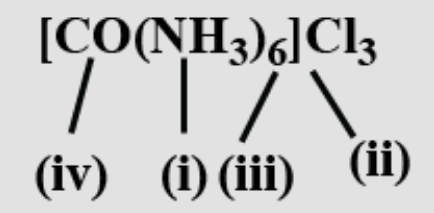
The correct labeling of different terms used in coordination compounds is:

The rate equation for the reaction $2A + B \to C$ is found to be : rate $ = k[A][B]$. The correct statement in relation to this reaction is that the
Consider the following sequence of reactions:

$PhC{{O}_{2}}H\xrightarrow[2.\,N{{H}_{3}}]{1.\,PC{{l}_{5}}}A\xrightarrow[2.\,{{H}_{2}}/Ni]{1.\,{{P}_{4}}{{O}_{10}}.heat}B.$ The final product $(B)$ is

Which one of the following is a polysaccharide
The yellow colour solution of $Na_2CrO_4$ changes to orange red on passing $CO_2$ gas due to the formation of
Product $(C)$ of the reaction is
A [Cr(H2​O)6​]3+ typically absorbs at around 574nm. It is allowed to react with ammonia to form a new complex [Cr(NH3​)6​]3+ that should have absorption at:
Which one of the following is incorrect for ideal solution ?
Amongst ${H_2}O,$ ${H_2}S,$ ${H_2}Se$ and ${H_2}Te$ the one with the highest boiling point is
An aqueous solution of hydrazine $\left( N _2 H _4\right)$ is electrochemically oxidized by $O _2$, thereby releasing chemical energy in the form of electrical energy. One of the products generated from the electrochemical reaction is $N _2( g )$.

Choose the correct statement($s$) about the above process

$(A)$ $OH ^{-}$ions react with $N _2 H _4$ at the anode to form $N _2( g )$ and water, releasing 4 electrons to the anode.

$(B)$ At the cathode, $N _2 H _4$ breaks to $N _2( g )$ and nascent hydrogen released at the electrode reacts with oxygen to form water.

$(C)$ At the cathode, molecular oxygen gets converted to $OH ^{-}$.

$(D)$ Oxides of nitrogen are major by-products of the electrochemical process.