MCQ
Compound $PdCl_4 .6H_2O$ is a hydrated complex; $1\, molal$ aqueous solution of it has freezing point $269.28\, K$. Assuming $100\%$ ionization of complex, calculate the molecular formula of the complex ($K_f$ for water $= 1.86\, K\, kg\, mol^{-1}$)
  • A
    $[Pd(H_2O)_6]Cl_4$
  • B
    $[Pd(H_2O)_4Cl_2]Cl_2.2H_2O$
  • $[Pd(H_2O)_3Cl_3]Cl.3H_2O$
  • D
    $[Pd(H_2O)_2Cl_4].4H_2O$

Answer

Correct option: C.
$[Pd(H_2O)_3Cl_3]Cl.3H_2O$
c

Need a full question paper?

Generate a complete, print-ready paper with questions like this in minutes — across 16+ boards, with answer keys.

Start Generating Free

Similar questions

How many $ml$ of $1 \,(M)$ ${H_2}S{O_4}$ is required to neutralise $10\, ml$ of $1 \,(M) $ $NaOH$ solution
For an electron, with $n = 3$ has only one radial node. The orbital angular momentum of the electron will be
Self condensation of two moles of ethyl acetate in presence of sodium ethoxide yields
Assertion : Potassium ferrocyanide is diamagnetic, whereas potassium ferricyanide is paramagnetic.

Reason : Crystal field splitting in ferrocyanide ion is greater than that of ferricyanide ion.

Which amino acid is achiral ?
The spin-only magnetic moment value of the compound with strongest oxidizing ability among $MnF _{4}, MnF _{3}$ and $MnF _{2}$ is $.............$ $B.M.$ [nearest integer]
$\underset{(A)}{\mathop{\begin{matrix}
   \,\,\,\,\,Ph\,\,\,\,C{{H}_{3}}  \\
   |\,\,\,\,\,\,\,\,\,\,|\,\,  \\
   Ph-C-C-C{{H}_{3}}  \\
   |\,\,\,\,\,\,\,\,\,\,|\,\,\,  \\
   \,OH\,\,\,OH  \\
\end{matrix}}}\,+\underset{(B)}{\mathop{\begin{matrix}
   \,\,\,\,Ph\,\,\,Et  \\
   \,\,|\,\,\,\,\,\,\,\,\,|  \\
   Ph-C-C-Et  \\
   \,\,|\,\,\,\,\,\,\,\,\,|  \\
   \,\,\,\,\,OH\,\,OH  \\
\end{matrix}}}\,\xrightarrow{{{H}_{2}}S{{O}_{4}}}$


$(p)$ $\begin{matrix}
   Ph\,\,\,\,\,O\,  \\
   |\,\,\,\,\,\,\,\,||\,\,  \\
   Ph-C-C-C{{H}_{3}}  \\
   |\,\,\,\,\,\,\,\,\,\,\,\,  \\
   C{{H}_{3}}\,\,\,\,\,\,\,\,  \\
\end{matrix}$                                $(q)$ $\begin{matrix}
   \,Ph\,\,\,\,\,O\,  \\
   \,\,|\,\,\,\,\,\,\,\,||  \\
   Ph-C-C-Et  \\
   |\,\,\,\,\,\,\,\,\,\,  \\
   Et\,\,\,\,\,\,\,\,\,\,  \\
\end{matrix}$

$(r)$ $\begin{matrix}
   \,Ph\,\,\,\,\,O\,  \\
   |\,\,\,\,\,\,\,\,\,\,||\,  \\
   Ph-C-C-C{{H}_{3}}  \\
   |\,\,\,\,\,\,\,\,\,\,\,\,\,\,  \\
   Et\,\,\,\,\,\,\,\,\,\,\,\,\,  \\
\end{matrix}$                             $(s)$ $\begin{matrix}
   \,\,\,Ph\,\,\,\,\,O\,  \\
   \,\,|\,\,\,\,\,\,\,\,||  \\
   Ph-C-C-Et  \\
   |\,\,\,\,\,\,\,\,\,\,  \\
   C{{H}_{3}}\,\,\,\,  \\
\end{matrix}$

When $(A)$ and $(B)$ reacts with $H_2SO_4$ products obtained are
Benzaldehyde on heating with acetone in presence of $NaOH$ gives 
What is the $pH$ of a solution in which $25.0\ mL$ of $0.1\ M\ NaOH$ is added to $25\ mL$ of $0.08\ M\ HCl$ and final solution is diluted to $500\ mL$ ?
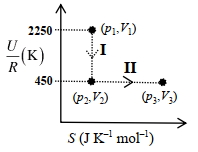
One mole of an ideal gas at $900 K$, undergoes two reversible processes, $I$ followed by $II$, as shown below. If the work done by the gas in the two processes are same, the value of $\ln \frac{V_3}{V_2}$ is. . . . . . . .  ( $U$ : internal energy, $S$ : entropy, $p$ : pressure, $V$ : volume, $R$ : gas constant) (Given: molar heat capacity at constant volume, $C_{V, m }$ of the gas is $\frac{5}{2} R$ )

( $U$ : आंतरिक ऊर्जा (internal energy), $S$ : एंट्रॉपी (entropy), $p$ : दाब (pressure), $V$ : आयतन (volume), $R$ : गैस नियतांक (gas constant)

(दिया गयाः स्थिर आयतन पर गैस की मोलर ऊष्माधारिता (molar heat capacity at constant volume), $C_{V, m }$ का मान $\frac{5}{2} R$ है)