MCQ
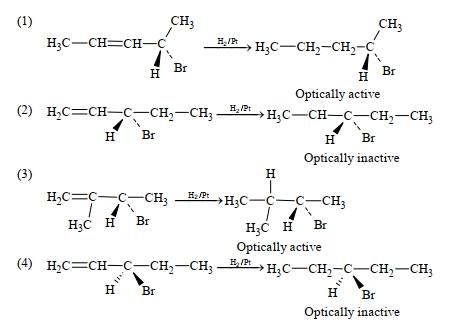
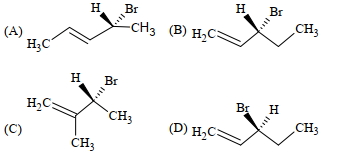
Compound$(s)$ that on hydrogenation produce$(s)$ optically inactive compound$(s)$ is (are)
  • A
    $(A,D)$
  • B
    $(A,C)$
  • C
    $(B,C)$
  • $(B,D)$

Answer

Correct option: D.
$(B,D)$
d

Need a full question paper?

Generate a complete, print-ready paper with questions like this in minutes — across 16+ boards, with answer keys.

Start Generating Free

Similar questions

The metal that has very low melting point and its periodic position is closer to a metalloid is.
.......... $(\%)$ percent of glucose solution is isotonic with $1.5\%\, (w/V)$ urea solution.
If current $(I)$ of an electrolytic cell is doubled and time $(t)$ for electrolysis is halved  then $\frac{mass}{eq.wt.}$ ratio becomes :-
Conductivity of $0.001\  M$ aq.solution of $Na_2SO_4$ is found to be $2.6 × 10^{-3}\  S\, cm^{-1}$ at $25\,^oC$. If limiting molar conductance of $Na^+$ is $50\  S\, cm^2 \,mol^{-1}$, then limiting molar conductance of $SO_4^{2-}$ will be .............. ${\rm{S}}\,{\rm{c}}{{\rm{m}}^2}{\rm{mo}}{{\rm{l}}^{ - 1}}$ (neglect conductivity of water).
What will be the amount of heat evolved by burning $0.4$ $moles$ of methane ?
(Given heats of formation of $CH_4, CO_2$ and $H_2O$ are $-75, -400$ and $-240\, kJ\, mol^{-1}$ respectively) .....$ kJ$
Two moles of an ideal monoatomic gases are allowed to expand adiabatically and reversibly from $300\, K$ to $200 \,K.$ The work done in the system is.....$kJ$ $(C_V = 12.5\, J/K/mol)$
Which of the following ion is the smallest ion
Tritium is the isotope of
For the process
$A(g) + e^-\to  A^-(g);$                   $\Delta H = x$
and $A^-(g) \to A(g) + e^-$              $\Delta H = y$
Select correct alternate :
The given data are for the reaction :

$2NO(g) + Cl_2(g) \to 2NOCl(g)$ at $298\, K$

$[Cl_2]$                $[NO]$                       Rate $(mol\, L^{-1} \sec^{-1})$

$I$    $0.05\, M$       $0.05\,M$                           $1 \times 10^{-3}$

$II$   $0.15\, M$      $0.05\,M$                           $3 \times 10^{-3}$

$III$  $0.05\, M$      $0.15\,M$                           $9 \times 10^{-3}$

The rate law for the reaction is