Question
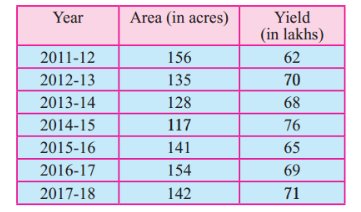
Compute the coefficient of variations for the following data to show whether the variation is greater in the field or in the area of the field.
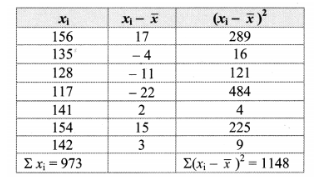
Here, $n =7, \bar{x}=\frac{\sum x_{ i }}{ n }=\frac{973}{7}=139$
$\operatorname{Var}(X)=\sigma_x^2=\frac{1}{ n } \sum\left(x_i-\bar{x}\right)^2=\frac{1148}{7}=164$
$\begin{aligned} & \text { S.D. }=\sigma_x=\sqrt{\operatorname{Var}( X )}=\sqrt{164}=12.8062 \\ & \text { Now, C.V. }=100 \times \frac{\sigma_x}{\bar{x}}=100 \times \frac{12.8062}{139}=9.21 \%\end{aligned}$
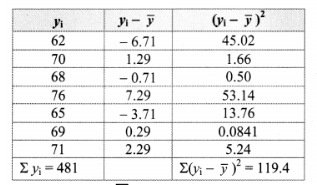
Here, $n =7, \bar{y}=\frac{\sum y_i}{ n }=\frac{481}{7}=68.71$
$\begin{aligned} & \operatorname{Var}( Y )=\sigma_y^2=\frac{1}{ n } \sum\left(y_i-\bar{y}\right)^2=\frac{119.4}{7}=17.0571 \\ & \text { S.D. }=\sigma_y=\sqrt{\operatorname{Var}( Y )}=\sqrt{17.0571}=4.13\end{aligned}$
Now, C.V. $=100 \times \frac{\sigma_y}{\bar{y}}=100 \times \frac{4.13}{68.71}=100 \times 0.0601=6.01 \%$
∴ the variation is greater in the area of the field.
Generate a complete, print-ready paper with questions like this in minutes — across 16+ boards, with answer keys.
|
classes
|
$95-105$
|
$105-115$
|
$115-125$
|
$125-135$
|
$135-145$
|
$145-155$
|
|
Frequencies
|
$9$
|
$13$
|
$16$
|
$26$
|
$30$
|
$12$
|