MCQ
Concentrated $H_2SO_4$ is not used to prepare $HBr$ from $KBr$ because it
- AOxidizes $HBr$ to $Br_2$
- ✓Reduces $HBr$
- CCauses disproportionation of $HBr$
- DReacts too slowly with $KBr$
Hybridization of $\mathrm{Si}-\mathrm{s} p^{3},$ bond angle $=109\,^o28'$
$\angle Cl-\text{N}-\text{Cl}$ in $NCl_3$ is greater than $\angle \text{Cl}-\text{P}-\text{Cl}$ in $\mathrm{PCl}_{3}$ because partidpation of $s-$ orbital in the hybridization decreases from $NCl_3$ to $PCl_3$
Figure $(2)$
$\angle \text{Cl}-\text{P}-\text{Cl}$ in $\text{PC}{{\text{l}}_{3}}>\angle \text{H}-\text{Sb}-\text{H}$ in $\mathrm{SbH}_{3},$ as in $\mathrm{SbH}_{3}$, bond pairs are formed by overlapping of almost pure $p-$ orbitals.
$\angle \text{H}-\text{Sb}-\text{H}$ in $\text{Sb}{{\text{H}}_{3}}<\angle \text{H}-\text{Te}-\text{H}$ in $\mathrm{H}_{2}Te$ because two lone pairs are present on $Te$ while at $\mathrm{Sb}$ there is one lone pair.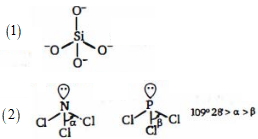
Generate a complete, print-ready paper with questions like this in minutes — across 16+ boards, with answer keys.
$X, Y$ and $Z$ can be described as
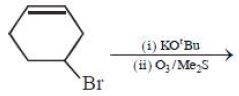
Compound $(C)$ is
$(i)$ Hinsberg test
$(ii)$ Carbyl amine test
$(iii)$ Hofmann mustard oil test
$(iv)$ $HNO_2$ test