MCQ
Conditions of diffraction is
  • $\frac{a}{\lambda } = 1$
  • B
    $\frac{a}{\lambda } > > 1$
  • C
    $\frac{a}{\lambda } < < 1$
  • D
    None of these

Answer

Correct option: A.
$\frac{a}{\lambda } = 1$
a
(a) For diffraction size of the obstacle must be of the order of wavelength of wave $i.e.$ $a \approx \lambda $

Need a full question paper?

Generate a complete, print-ready paper with questions like this in minutes — across 16+ boards, with answer keys.

Start Generating Free

Similar questions

What is the stopping potential when the metal with work function $0.6 eV$ is illuminated with the light of $2 eV$ ............ $V$
Statement$-I :$ To get a steady de output from the pulsating voltage received from a full wave rectifier we can connect a capacitor across the output parallel to the load ${R}_{{L}}$

Statement$-II :$ To get a steady de output from the pulsating voltage received from a full wave rectifier we can connect an inductor in series with ${R}_{{L}}$.

In the light of the above statements, choose the most appropriate answer from the options given below:

The binding energy of nucleons in a nucleus can be affected by the pairwise Coulomb repulsion. Assume that all nucleons are uniformly distributed inside the nucleus. Let the binding energy of a proton be $E_b^p$ and the binding energy of a neutron be $E_b^n$ in the nucleus.

Which of the following statement($s$) is(are) correct?

$(A)$ $E_b^p-E_b^n$ is proportional to $Z(Z-1)$ where $Z$ is the atomic number of the nucleus.

$(B)$ $E_b^p-E_b^n$ is proportional to $A^{-\frac{1}{3}}$ where $A$ is the mass number of the nucleus.

$(C)$ $E_b^p-E_b^n$ is positive.

$(D)$ $E_b^p$ increases if the nucleus undergoes a beta decay emitting a positron.

An infinite line charge produce a field of $7.182 \times {10^8}\,N/C$ at a distance of $2\, cm$. The linear charge density is
During an experiment, an ideal gas is found to obey a condition $VP^2 =$ constant. The gas is initially at a temperature $T$, pressure $P$ and volume $V.$ The gas expands to volume $4V$. 
A spiral galaxy can be approximated as an infinitesimally thin disc of a uniform surface mass density (mass per unit area) located at $z=0$. Two stars $A$ and $B$ start from rest from heights $2 z_{0}$ and $z_{0}$ $\left(z_{0} < <  \right.$ radial extent of the disc), respectively and fall towards the disc, cross over to the other side and execute periodic oscillations. The ratio of time periods of $A$ and $B$ is
A source $S_1$ is producing, $10^{15}$ photons per second of wavelength $5000 \;\mathring A.$ Another source $S_2$ is producing $1.02 \times 10^{15}$ photons per second of wavelength $5100\;\mathring A$. Then, $($ power of $S_2)/$  $($ power of $S_1)$ is equal to
Which of the following equations represents a wave
A coil is placed in magnetic field such that plane of coil is perpendicular to the direction of magnetic field. The magnetic flux through a coil can be changed:

$A.$ By changing the magnitude of the magnetic field within the coil.

$B.$ By changing the area of coil within the magnetic field.

$C.$ By changing the angle between the direction of magnetic field and the plane of the coil.

$D.$ By reversing the magnetic field direction abruptly without changing its magnitude.

Choose the most appropriate answer from the options given below
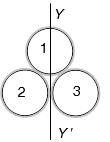
Three rings each of mass $M$ and radius $R$ are arranged as shown in the figure. The moment of inertia of the system about $YY' $ will be