Question
Conisder the matrices
$A=\left[\begin{array}{rrr} 2 & 1 & 3 \\ 3 & -2 & 1 \\ -1 & 0 & 1 \end{array}\right], B=\left[\begin{array}{rr} 1 & -2 \\ 2 & 1 \\ 4 & 3 \end{array}\right], C=\left[\begin{array}{lll} 1 & 2 & 6 \end{array}\right] $
Then, which of the following is not defined?
Answer

(a) BA
Explanation: The given matrices are
$A=\left[\begin{array}{rrr}2 & 1 & 3 \\3 & -2 & 1 \\-1 & 0 & 1\end{array}\right], B=\left[\begin{array}{rr}1 & -2 \\2 & 1 \\4 & 3\end{array}\right] \text {, and } C=\left[\begin{array}{lll}1 & 2 & 6\end{array}\right]$
The order of $A$ is $3 \times 3$, order of $B$ is $3 \times 2$ and order of $C$ is $1 \times 3$.
$\therefore CA , AB$ and CB are all defined.
But BA is not defined as number of columns in B is not equal to the number of rows in A .

Need a full question paper?

Generate a complete, print-ready paper with questions like this in minutes — across 16+ boards, with answer keys.

Start Generating Free

Similar questions

The sine of the angle between the straight line $\frac{\text{x}-2}{3}=\frac{\text{y}-3}{4}=\frac{\text{z}-4}{5}$ and the plane 2x - 2y + z = 5 is:
  1. $\frac{10}{6\sqrt{5}}$
  2. $\frac{4}{5\sqrt{2}}$
  3. $\frac{2\sqrt{3}}{5}$
  4. $\sqrt{\frac{\sqrt{2}}{10}}$
$\int\frac{\sin\text{x}}{3+4\cos^2\text{x}}\text{ dx}=$
  1. $\log(3+4\cos^2\text{x})+\text{C}$
  2. $\frac{1}{2\sqrt{3}}\tan^{-1}\Big(\frac{\cos\text{x}}{\sqrt{3}}\Big)+\text{C}$
  3. $-\frac{1}{2\sqrt{3}}\tan^{-1}\Big(\frac{2\cos\text{x}}{\sqrt{3}}\Big)+\text{C}$
  4. $\frac{1}{2\sqrt{3}}\tan^{-1}\Big(\frac{2\cos\text{x}}{\sqrt{3}}\Big)+\text{C}$
Consider the binary operation * defined on Q − {1} by the rule a * b = a + b − ab for all a, b ∈ Q − {1}. The identity element in Q − {1} is:
  1. $0$
  2. $1$
  3. $\frac{1}2$
  4. $-1$
The integrating factor of the differential equation $\text{x}\frac{\text{dy}}{\text{dx}}-\text{y}=2\text{x}^{2}.$
  1. $\text{e}^{-\text{x}}$
  2. $\text{e}^{-\text{y}}$
  3. $\frac{1}{\text{x}}$
  4. $\text{x}$
Five fair coins are tossed simultaneously. The probability of the events that atleast one head comes up is
If m and n are the order and degree of the differential equation $(\text{y}_{2})^{5}+\frac{4(\text{y}_{2})^{3}}{\text{y}^{3}}+\text{y}^{3}=\text{y}_{3}=\text{x}^{2}-1$, then
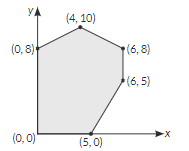
The feasible region for an LPP is shown below: Let $z=3 x-4 y$ be the objective function. Minimum of $z$ occurs at
Image
Let R be a relation on N defined by x + 2y = 8. The domain of R is:
  1. {2, 4, 8}
  2. {2, 4, 6, 8}
  3. {2, 4, 6}
  4. {1, 2, 3, 4}
The length of perpendicular from the origin to the plane which makes intercepts $\frac{1}{3},\frac{1}{4},\frac{1}{5}$​ respectively on the coordinate axes is:
  1. $\frac{1}{\sqrt[5]{2}}$
  2. $\frac{1}{10}$
  3. $\sqrt[5]{2}$
  4. $5$
 
If $\tan^{-1}3+\tan^{-1}\text{x}=\tan^{-1}8,$ then x =
  1. $5$
  2. $\frac{1}{5}$
  3. $\frac{5}{14}$
  4. $\frac{14}{5}$