MCQ
Conjugate base for Bronsted acids $\mathrm{H}_{2} \mathrm{O}$ and $\mathrm{HF}$ are
  • A
    $\mathrm{OH}^{-}$ and $\mathrm{H}_{2} \mathrm{F}^{+}$ respectively
  • B
    $\mathrm{H}_{3} \mathrm{O}^{+}$ and $\mathrm{F}^{-},$ respectively
  • $\mathrm{OH}^{-}$ and $\mathrm{F}^{-},$ respectively
  • D
    $\mathrm{H}_{3} \mathrm{O}^{+}$ and $\mathrm{H}_{2} \mathrm{F}^{+},$ respectively
Answer

Correct option: C.
$\mathrm{OH}^{-}$ and $\mathrm{F}^{-},$ respectively
c
Conjugate base of $\mathrm{H}_{2} \mathrm{O}$ is $\mathrm{OH}^{-}$

Conjugate base of $HF$ is $F^-$

Need a full question paper?

Generate a complete, print-ready paper with questions like this in minutes — across 16+ boards, with answer keys.

Start Generating Free

Similar questions

In which of the following compounds nitrogen exhibits highest oxidation state ?
Assertion : For a reaction $2NH_3(g) \to N_2(g) + 3H_2 (g)$ ; $\Delta H > \Delta E$.
Reason : Enthalpy change is always greater than internal energy change.
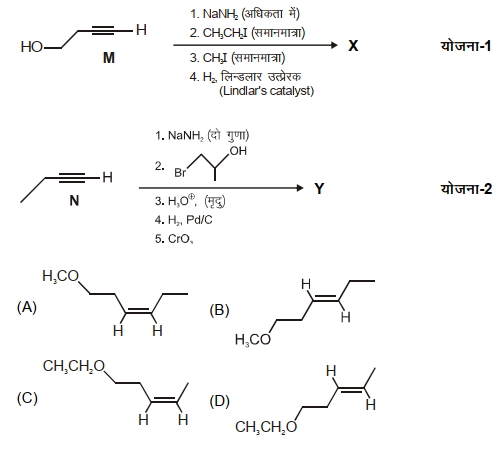
Schemes $1$ and $2$ describe sequential transformation of alkynes $M$ and $N$. Consider only the major products formed in each step for both the schemes. $Image$

$1.$ The product $X$ is

mcq $Image$

$2.$ The correct statement with respect to product $Y$ is :

$(A)$ It gives a positive Tollens test and is a functional isomer of $X$.

$(B)$ It gives a positive Tollens test and is a geometrical isomer of $X$.

$(C)$ It gives a positive iodoform test and is a functional isomer of $X$.

$(D)$ It gives a positive iodoform test and is a geometrical isomer of $X$.

Give the answer question $1$ and $2.$

Equivalent weight of a bivalent metal is $37.2$. The molecular weight of its chloride is
Consider the following reaction in which the intermediate carbocation loses $H^+$  to give the final product ? 

Which of the following energy profiles best represents the overall reaction ?

In $C,\,N,\,O$ and $F$ the electronegativity
What will be the major product of following sequence of reactions?

$n - Bu -\equiv\frac{(i) n-BuLi,n - C _{5} H _{11} Cl}{(ii) Lindlar\,\, cat, H _{2}}$

All the hydrocarbons shown are very weak acids. One, however, is far more acidic  than the others. Which one is the strongest acid ?
Consider the elements: Cs, Ne, I and F. Identify the element(s) which exhibits neither the negative nor does the positive oxidation state.
Consider the reactions given below. On the basis of these reactions find out which of the algebric relations given in options (i) to (iv) is correct?

  1. $\text{C}(\text{g})+4\text{H}(\text{g})\rightarrow\text{CH}_4(\text{g});\Delta_\text{r}\text{H}=\text{x}\text{kJ}\ \text{mol}^{-1}$

  2. $\text{C}(\text{graphite,s})+2\text{H}_2(\text{g})\rightarrow\text{CH}_4(\text{g});\Delta_\text{r}\text{H}=\text{y}\text{kJ}\ \text{mol}^{-1}$​​​​
