MCQ
Connecting wires carrying currents in opposite directions are twisted together in using electrical appliances in order to reduce
  • A
    Electrical effect
  • Magnetic effect
  • C
    Seebeck effect
  • D
    Peltier effect

Answer

Correct option: B.
Magnetic effect
b
(b)

Connecling wires are twisted in electrical appliances so that the resultant magnetic fields from consecutive twists are in opposite directions So umulative magnetic effect over a long length will beroughly Zero

Need a full question paper?

Generate a complete, print-ready paper with questions like this in minutes — across 16+ boards, with answer keys.
Start Generating Free

Similar questions

A thin circular ring first slips down a smooth incline then rolls down a rough incline of identical geometry from same height. Ratio of time taken in the two motion is ........
For measurement of potential difference, potentiometer is preferred in comparison to voltmeter because
The area of the hole of heat furnace is $10^{-4}\,m^2.$ It radiates $1.58\times 10^5\,cal$ of heat per hour. If the emissivity of the furnace is $0.80,$ then its temperature is .......... $K$
The resistance of a conductor increases with
If $x, v$ and $a$ denote the displacement, the velocity and the acceleration of a particle executing simple harmonic motion of time period $T$, then, which of the following does not change with time?
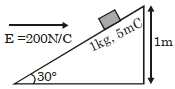
An inclined plane making an angle of $30^{\circ}$ with the horizontal is placed in a uniform horizontal electric field $200 \, \frac{ N }{ C }$ as shown in the figure. A body of mass $1\, kg$ and charge $5\, mC$ is allowed to slide down from rest at a height of $1\, m$. If the coefficient of friction is $0.2,$ find the time (in $s$ )taken by the body to reach the bottom. $\left[ g =9.8 \,m / s ^{2}, \sin 30^{\circ}=\frac{1}{2}\right.$; $\left.\cos 30^{\circ}=\frac{\sqrt{3}}{2}\right]$
The ionisation energy of hydrogen atom is $13.6\; eV$, the ionisation energy of a singly ionised helium atom would be  ....... $eV$
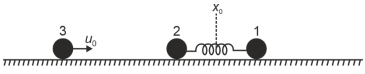
Two particles, $1$ and $2$ , each of mass $m$, are connected by a massless spring, and are on a horizontal frictionless plane, as shown in the figure. Initially, the two particles, with their center of mass at $x_0$, are oscillating with amplitude a and angular frequency $\omega$. Thus, their positions at time $t$ are given by $x_1(t)=\left(x_0+d\right)+a \sin \omega t$ and $x_2(t)=\left(x_0-d\right)-$ $a$ sin $\omega t$, respectively, where $d>2 a$. Particle $3$ of mass $m$ moves towards this system with speed $u_0=a \omega / 2$, and undergoes instantaneous elastic collision with particle 2 , at time $t_0$. Finally, particles $1$ and $2$ acquire a center of mass speed $v_{ cm }$ and oscillate with amplitude $b$ and the same angular frequency. . . . .

($1$) If the collision occurs at time $t_0=0$, the value of $v_{ cm } /(a \omega)$ will be

($2$) If the collision occurs at time $t_0=\pi /(2 \omega)$, then the value of $4 b^2 / a^2$ will be

Give the answer or quetion ($1$) and ($2$)
Two stars of masses $m$ and $2\, m$ at a distance $d$ rotate about their common centre of mass in free space. The period of revolution is
An aeroplane in which the distance between the tips of wings is $50$ $m$ is flying horizontally with a speed of $360$ $km/hr$ over a place where the vertical components of earth magnetic field is $2.0 \times {10^{ - 4}}\,weber/{m^2}$. The potential difference between the tips of wings would be......$V$