MCQ
Consider a $70 \%$ efficient hydrogen-oxygen fuel cell working under standard conditions at 1 bar and $298 K$. Its cell reaction is

$H _2( g )+\frac{1}{2} O _2( g ) \rightarrow H _2 O (\ell)$

The work derived from the cell on the consumption of $1.0 \times 10^{-3} mol$ of $H _2( g )$ is used to compress $1.00 mol$ of a monoatomic ideal gas in a thermally insulted container. What is the change in the temperature (in $K$ ) of the ideal gas ?

The standard reduction potentials for the two half-cells are given below.

$\left. O _2( g )+4 H ^{+} \text {(aq. }\right)+4 e ^{-} \rightarrow 2 H _2 O (\ell), E ^{\circ}=1.23 V,$

$\left.2 H ^{+} \text {(aq. }\right)+2 e ^{-} \rightarrow H _2( g ), E ^{\circ}=0.00 V.$

Use $F =96500 C mol ^{-1}, R =8.314 J mol ^{-1} K ^{-1}$

  • $13.32$
  • B
    $13.35$
  • C
    $13.40$
  • D
    $13.45$

Answer

Correct option: A.
$13.32$
a
$E _{\text {cell }}^0=1.23-0.00=1.23 V$

$\Delta G _{\text {cell }}^0=- nF E _{\text {cell }}^0=-2 \times 96500 \times 1.23 J$

$\therefore \quad$ Work derived from this fuel cell

$=\frac{70}{100} \times\left(-\Delta G _{\text {cell }}^0\right) \times 10^{-3}= xJ$

Since insulated vessel, hence $q=0$

From equation, for monoatomic gas,

$w =\Delta U \quad \Rightarrow \quad x = nC _{ V _{ m }} \Delta T \left\{ C _{ V _{ m }}=\frac{3 R }{2}\right\}$

or,$\quad \frac{70}{100} \times(2 \times 96500 \times 1.23) \times 10^{-3}=1 \times \frac{3}{2} \times 8.314 \times \Delta T$

$\therefore \quad \Delta T =13.32$

Need a full question paper?

Generate a complete, print-ready paper with questions like this in minutes — across 16+ boards, with answer keys.

Start Generating Free

Similar questions

Match the industrial process ( Column -$1$) with the catalyst used and (Column $-2$) and select the correct option.
Column $-1$ Column $-2$
$(A)$  Haber's process for ammonia  $(P)$ Zeolite
$(B)$  Oswald's process for $HNO_3$ $(Q)$ $Fe$
$(C)$  Contact processf $H_2SO_4$ $(R)$  $ V_2O_5$
$(D)$  Cracking of hydrocarbons  $(S)$  $Pt$ gauge
$1 \,M$  $NaCl$ and $1 \,M$  $HCl$ are present in an aqueous solution. The solution is
Which of the following are tautomers
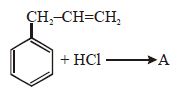
What is $'A'$ in the following reaction
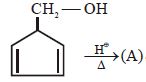
Product $(A)$ is
When chlorine reacts with cold and dilute solution of sodium hydroxide , the products obtained are
The energy required to remove an electron of a gaseous atom from its ground state is called
The major product of the following reaction is
In the given reaction $'x$' is

$C{H_3} - C \equiv CH\xrightarrow{{Excess\,\, HCl}}\left( A \right)\xrightarrow{{{H_2}O/O{H^\Theta }}}\left( x \right)$

Given below are two statements: one is labelled as Assertion $(A)$ and the other is labelled as Reason $(R)$

Assertion $(A) :$ At $10^{\circ} C$, the density of a $5\, M$ solution of $KCl$ [atomic masses of $K$ and $Cl$ are $39$ and $35.5\, g \,mol ^{-1}$ ]. The solution is cooled to $-21^{\circ} C$. The molality of the solution will remain unchanged.

Reason $(R):$ The molality of a solution does not change with temperature as mass remains unaffected with temperature.

In the light of the above statements, choose the correct answer from the options given below