MCQ
Consider a capacitor$-$charging circuit. Let $Q_1$ be the charge given to the capacitor in a time interval of $10 \ ms$ and $Q_2$ be the charge given in the next time interval of $10 \ ms$ . Let $10 \ mC$ charge be deposited in time interval $t _1$ and another $10 \ mC$ charge be deposited in the next time interval $t _2$.
  • A
    $Q _1 > Q _2, t _1 > t _2$
  • $Q _1> Q _2, t _1< t _2$
  • C
    $Q _1< Q _2, t _1> t _2$
  • D
    $Q _1< Q _2, t _1< t _2$

Answer

Correct option: B.
$Q _1> Q _2, t _1< t _2$
Condition for charging capacitor-
$\text{Q}=\text{Q}_0\Big(1-\text{e}^\frac{-\text{t}}{\text{Rc}}\Big)$
$\text{Q}=\text{Q}_0\Big(1-\text{e}^\frac{-10\text{m}}{\text{Rc}}\Big)\ ...(1)$
$\text{Q}_1=\text{Q}_2=\text{Q}_0\Big(1-\text{e}^\frac{{-(10\text{m}+10\text{m})}}{\text{Rc}}\Big)$
$\text{Q}_1=\text{Q}_2=\text{Q}_0\Big(1-\text{e}^\frac{{-20\text{m}}}{\text{Rc}}\Big)\ ...(2)$
From eq. $(1)$ and $(2)$ we get-
$\text{Q}_1 > \text{Q}_2$
Given
$\text{Q}=\text{Q}_0\Big(1-\text{e}^\frac{-\text{t}}{\text{Rc}}\Big)$
$10\text{mc}=\text{Q}_0\Big(1-\text{e}^{\frac{-\text{t}}{\text{Rc}}}\Big)\ ...(3)$
$10\mu\text{c}+10\mu\text{c}=\text{Q}_0\Big(1-\text{e}^{\frac{-(\text{t}_1+\text{t}_2)}{\text{Rc}}}\Big)\rightarrow$
$20\mu\text{c}=\text{Q}_0\Big(1-\text{e}^{\frac{-(\text{t}_1+\text{t}_2)}{\text{Rc}}}\Big)\ ...(4)$
From eq. $(3)$ and $(4)$ we get,
$\text{t}_2 > \text{t}_1$

Need a full question paper?

Generate a complete, print-ready paper with questions like this in minutes — across 16+ boards, with answer keys.

Start Generating Free

Similar questions

Four identical pendulums are made by attaching a small ball of mass $100 \,g$ on a $20 \,cm$ long thread and suspended from the same point. Now, each ball is given charge $Q$, so that balls move away from each other with each thread making an angle of $45^{\circ}$ from the vertical. The value of $Q$ is close to ..............$\mu C$ $\left(\frac{1}{4 \pi \varepsilon_0}=9 \times 10^9\right.$ in $SI$ units $)$
It is essential to consider light as a stream of photons to explain:
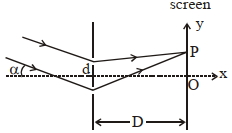
In a Young's double slit experiment, the slit separation d is $0.3 mm$ and the screen distance $D$ is $1 m$. A parallel beam of light of wavelength $600 nm$ is incident on the slits at angle $\alpha$ as shown in figure. On the screen, the point $O$ is equidistant from the slits and distance $PO$ is $11.0 mm$. Which of the following statement($s$) is/are correct ?
The electric field in a region is given by $\overrightarrow{ E }=\frac{2}{5} E _{0} \hat{ i }+\frac{3}{5} E _{0} \hat{ j }$ with $E _{0}=4.0 \times 10^{3}\, \frac{ N }{ C } .$ The flux of this field through a rectangular surface area $0.4 \,m ^{2}$ parallel to the $Y - Z$ plane is ....... $Nm ^{2} C ^{-1}$
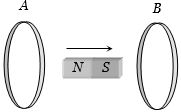
In the diagram shown if a bar magnet is moved along the common axis of two single turn coils $A$ and $B$ in the direction of arrow
Einstein's photoelectric equation states that ${E_k} = h\nu - \phi $. In this equation ${E_k}$ refers to
The dominant mechanisms for motion of charge carriers in forward and reverse biased silicon P-N junctions are
A positively charged particle moving along $x$-axis with a certain velocity enters a uniform electric field directed along positive $y$-axis. Its
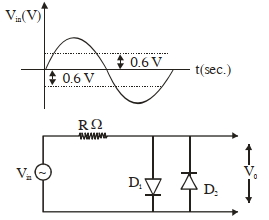
In the given circuit the input voltage $V _{\text {in }}$ is shown in figure. The cut-in voltage of $p - n$ junction diode ( $D_{1}$ or $D_{2}$ ) is $0.6\,V$. Which of the following output voltage $\left( V _{0}\right)$ waveform across the diode is correct?
Assertion : If a proton and an electron are placed in the same uniform electric field. They experience different acceleration.
Reason : Electric force on a test charge is independent of its mass.