MCQ
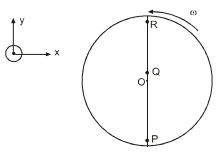
Consider a disc rotating in the horizontal plane with a constant angular speed $\omega$ about its centre $O$. The disc has a shaded region on one side of the diameter and an unshaded region on the other side as shown in the figure. When the disc is in the orientation as shown, two pebbles $P$ and $Q$ are simultaneously projected at an angle towards $R$. The velocity of projection is in the $y$-z plane and is same for both pebbles with respect to the disc. Assume that $(i)$ they land back on the disc before the disc completed $\frac{1}{8}$ rotation. $(ii)$ their range is less than half disc radius, and $(iii)$ $\omega$ remains constant throughout. Then
  • A
    $P$ lands in the shaded region and $Q$ in the unshaded region
  • B
    $P$ lands in the unshaded region and $Q$ in the shaded region
  • Both $P$ and $Q$ land in the unshaded region
  • D
    Both $P$ and $Q$ land in the shaded region
Answer

Correct option: C.
Both $P$ and $Q$ land in the unshaded region
c
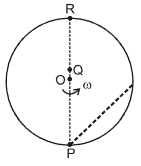
Since distance of particle $P$ from point $O$ is initially decreasing then increasing so, its angular velocity $w$ initially increase then decrease. So, angle swept by $P$ is more than angle swept by disc. So it will fall unshaded portion.

Since distance of particle $Q$ from $O$ is continuously increasing so its $\omega$ is continuously decreasing. So ang swept by $Q$ is less than angle swept by disc. So it will fall in unshaded portion.

Need a full question paper?

Generate a complete, print-ready paper with questions like this in minutes — across 16+ boards, with answer keys.

Start Generating Free

Similar questions

A particle has a mass $400$ times than that of the electron and charge is double than that of a electron. It is accelerated by $5\,V$ of potential difference. Initially the particle was at rest, then its final kinetic energy will be......$eV$
Two wheels are connected by a belt. The radius of larger wheel is three times that of the smaller one. What is the ratio of the rotational inertia of larger wheel to the smaller wheel, when both wheels have same angular momentum ?
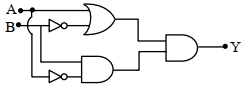
The output $\mathrm{Y}$ of following circuit for given inputs is :
The current voltage relation of a diode is given by $I=(e^{1000V/T} -1)mA$ where the applied voltage $V$ is in volts and the temperature $T$ is in degree kelvin. If a student makes an error measuring $±0.01\ V$ while measuring the current of $5\ mA$ at $300\ K$, what will be the error in the value of current in $mA?$
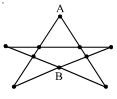
The resistance of all the wires between any two adjacent dots is $R$. Then equivalent resistance between $A$ and $B$ as shown in figure is :
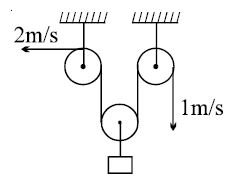
Find the velocity of the hanging block if the velocities of the free ends of the rope are as indicated in the figure.
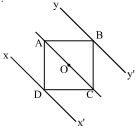
Let $I_1, I_2$ and $I_3$ be the moment of inertia of a uniform square plate about axes $AOC, xDx'$ and $yBy'$ respectively as shown in the figure. The moments of inertia of the plate $I_1 : I_2 : I_3$ are in the ratio.
A gas consisting of a rigid diatomic molecules was initially under standard condition. Then, gas was compressed adiabatically to one$-$fifth of its initial volume. What will be the mean kinetic energy of a rotating molecule in the final state ?
A small mass $'m'$ rests at the edge of a horizontal disc of radius $'R'$ . The coefficient of static friction between mass and the disc is $\mu $ . The disc is rotated about its axis at an angular velocity such that the mass slides off the disc and lands on the floor $'h'$ meters below. What was its horizontal distance of travel from the point it left the disc?
A nucleus decays by ${\beta ^ + }$ emission followed by a gamma emission. If the atomic and mass numbers of the parent nucleus are $Z$ and $A$ respectively, the corresponding numbers for the daughter nucleus are respectively.