Consider a finite insulated, uncharged conductor placed near a finite positively charged conductor. The uncharged body must have a potential
JEE MAIN 2013, Diffcult


Download our appand get started for free
Experience the future of education. Simply download our apps or reach out to us for more information. Let's shape the future of learning together!No signup needed.*
Similar Questions
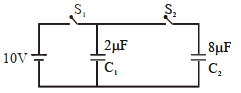
- 1A $2\, \mu F$ capacitor $C _{1}$ is first charged to a potential difference of $10\, V$ using a battery.Then the battery is removed and the capacitor is connected to an uncharged capacitor $C _{2}$ of $8\, \mu F$. The charge in $C _{2}$ on equilibrium condition is $\ldots\,\mu C$. (Round off to the Nearest Integer)View Solution
- 2Four identical charges $ + \,50\,\mu C$ each are placed, one at each corner of a square of side $2\,m$. How much external energy is required to bring another charge of $ + \,50\,\mu C$ from infinity to the centre of the square......$J$ $\left( {{\rm{Given}}\frac{{\rm{1}}}{{{\rm{4}}\pi {\varepsilon _{\rm{0}}}}} = 9 \times {{10}^9}\,\frac{{N{m^2}}}{{{C^2}}}} \right)$View Solution
- 3View SolutionWhen a lamp is connected in series with capacitor, then
- 4Between the plates of a parallel plate condenser there is $1\,mm$ thick paper of dielectric constant $4$. It is charged at $100\;volt$. The electric field in $volt/metre$ between the plates of the capacitor isView Solution
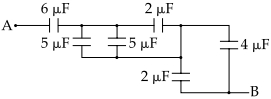
- 5The equivalent capacitance between $A$ and $B$ in the circuit given below is.....$μF$View Solution
- 6A small conducting sphere of radius $r$ is lying concentrically inside a bigger hollow conducting sphere of radius $R.$ The bigger and smaller spheres are charged with $Q$ and $q (Q > q)$ and are insulated from each other. The potential difference between the spheres will beView Solution
- 7An electric charge ${10^{ - 3}}\,\mu \,C$ is placed at the origin $(0, 0)$ of $X -Y$ co-ordinate system. Two points $A$ and $B$ are situated at $\left( {\sqrt {2\,} \,,\,\,\sqrt 2 } \right)$ and $(2, 0)$ respectively. The potential difference between the points $A$ and $B$ will be......$volt$View Solution
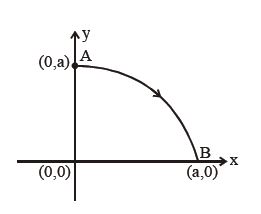
- 8Electric field at a place is $\overrightarrow {E\,} = {E_0}\hat i\,V/m$ . A particle of charge $+q_0$ moves from point $A$ to $B$ along a circular path find work done in this motion by electric fieldView Solution
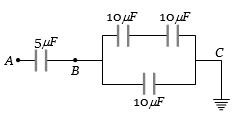
- 9In the given circuit if point $C$ is connected to the earth and a potential of $ + \,2000\,V$ is given to the point $A$, the potential at $B$ is.....$V$View Solution
- 10The variation of electrostatic potential with radial distance $r$ from the centre of a positively charged metallic thin shell of radius $R$ is given by the graphView Solution