MCQ
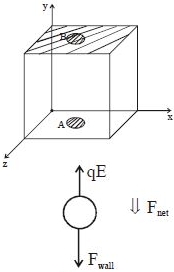
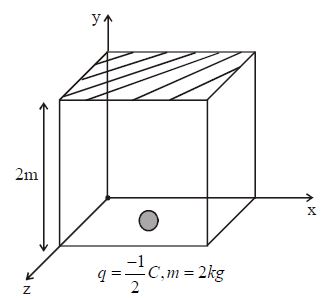
Consider a gravity free container as shown. System is initially at rest and electric potential in the regon is $V = (y^3+2)\  J/C$. A ball of charge $q$ and mass $m$ is released from rest from base starts to move up due to electric field and collides with the shaded face as shown.If its speed just after collision is $1.5\  m/s$ and time for which ball is in contact with shaded face is $0.1\ sec$, find external force required to hold the container fixed in its position during collision assuming ball exerts constant force on wall during entire span of collision.......$N$
  • A
    $70$
  • B
    $72$
  • C
    $74$
  • $76$

Answer

Correct option: D.
$76$
d
$\mathrm{V}=\mathrm{y}^{3}+2$

$\Rightarrow \mathrm{E}=\frac{-\delta V}{\delta y} \hat{i}=-3 y^{2} \hat{j}$

$\mathrm{V}_{\mathrm{A}}=2 \mathrm{\,volt}$

$\mathrm{V}_{\mathrm{B}}=10$ volt $\left[\mathrm{V}=\mathrm{y}^{3}+2\right]$

$\mathrm{q}\left(\mathrm{V}_{\mathrm{B}}-\mathrm{V}_{\mathrm{A}}\right)=\frac{1}{2} m v^{2} \Rightarrow \frac{1}{2}(8)=\frac{1}{2}(2) \,V^{2}$

$\Rightarrow \mathrm{V}=2 \mathrm{\,m} / \mathrm{s}$

So, velocity of ball before collision $ = (2{\rm{\,m}}/{\rm{s}})j$

So, velocity of ball after collision $ =  - (1.5\,{\rm{m}}/{\rm{s}})j$

change in momentum $ = m\left( {{{\overrightarrow V }_F} - {{\overrightarrow V }_i}} \right) = ( - 7\,N.S)j$

Net force $ = ( - 7)/(0.1) = ( - 70\,{\rm{N}}){\rm{j}}$

from $\mathrm{FBD}$ of ball during collision

${{\rm{F}}_{{\rm{net}} = }}{\rm{ = }}{{\rm{F}}_{{\rm{wall}}}} - {\rm{qE}}$

$\mathrm{F}_{\mathrm{wall}}=\mathrm{F}_{\mathrm{net}}+\mathrm{q} \mathrm{E}$

$=(70+6)=76 \mathrm{\,N}$

${\rm{[E}}$ at top face $ = 3{{\rm{y}}^2} = 3{(2)^2} = 12\,{\mkern 1mu} {\rm{N}}/{\rm{C]}}$

Need a full question paper?

Generate a complete, print-ready paper with questions like this in minutes — across 16+ boards, with answer keys.

Start Generating Free

Similar questions

A gas is suddenly compressed to one fourth of its original volume. What will be its final pressure, if its initial pressure is $P$
Two infinitely long straight wires lie in the $\mathrm{xy}$-plane along the lines $\mathrm{x}=+R$. The wire located at $\mathrm{x}=+\mathrm{R}$ carries a constant current $\mathrm{I}_1$ and the wire located at $\mathrm{x}=-R$ carries a constant current $\mathrm{I}_2$. A circular loop of radius $R$ is suspended with its centre at $(0,0, \sqrt{3} R)$ and in a plane parallel to the xy-plane. This loop carries a constant current $/$ in the clockwise direction as seen from above the loop. The current in the wire is taken to be positive if it is in the $+\hat{\mathrm{j}}$ direction. Which of the following statements regarding the magnetic field $\dot{B}$ is (are) true?

$(A)$ If $I_1=I_2$, then B' cannot be equal to zero at the origin $(0,0,0)$

$(B)$ If $\mathrm{I}_1>0$ and $\mathrm{I}_2<0$, then $\mathrm{B}$ can be equal to zero at the origin $(0,0,0)$

$(C)$ If $\mathrm{I}_1<0$ and $\mathrm{I}_2>0$, then $\mathrm{B}$ can be equal to zero at the origin $(0,0,0)$

$(D)$ If $\mathrm{I}_1=\mathrm{I}_2$, then the $\mathrm{z}$-component of the magnetic field at the centre of the loop is $\left(-\frac{\mu_0 \mathrm{I}}{2 \mathrm{R}}\right)$

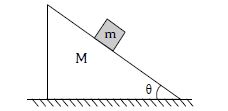
A block of mass $m$ slides down on a wedge of mass $M$ as shown in figure. Let $\vec a_1$ be the acceleration of the wedge and $\vec a_2$  the acceleration of block w.r.t. ground. $N_1$ is the normal reaction between block and wedge and $N_2$ the normal reaction between wedge and ground. Friction is absent everywhere. Select the incorrect alternative
Of the following pairs of species which one will have the same electronic configuration for both members?
The value of g on the earth's surface is $980\,cm/{\sec ^2}$. Its value at a height of $64 \,km$ from the earth's surface is ........ $cm/{\sec ^2}$

(Radius of the earth $R = 6400$ kilometers) 

An object is located in a fixed position in front of a screen. Sharp image is obtained on the screen for two positions of a thin lens separated by $10\, cm$. The size of the images in two situations are in the ratio $3 : 2$. What is the distance between the screen and the object?......$cm$
A body of mass $5\; kg$ hangs from a spring and oscillates with a time period of $2\pi $ seconds. If the ball is removed, the length of the spring will decrease by
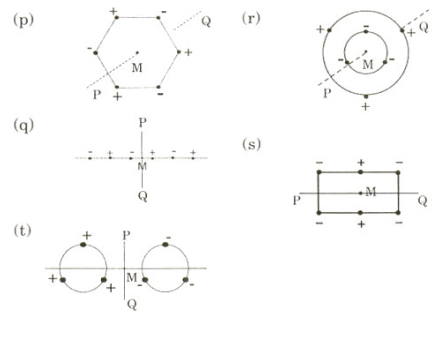
Six point charges, each of the same magnitude $q$, are arranged in different manners as shown in Column $II$. In each case, a point $\mathrm{M}$ and a line $\mathrm{PQ}$ passing through $\mathrm{M}$ are shown. Let $E$ be the electric field and $V$ be the electric potential at $\mathrm{M}$ (potential at infinity is zero) due to the given charge distribution when it is at rest. Now, the whole system is set into rotation with a constant angular velocity about the line $PQ$. Let $B$ be the magnetic field at $\mathrm{M}$ and $\mu$ be the magnetic moment of the system in this condition. Assume each rotating charge to be equivalent to a steady current.
Column $I$ Column $II$
$(A)$ $E=0$ $Image$ Charges are at the corners of a regular hexagon. $\mathrm{M}$ is at the centre of the hexagon. $\mathrm{PQ}$ is perpendicular to the plane of the hexagon.
$(B)$ $V \neq 0$ $Image$ Charges are on a line perpendicular to $\mathrm{PQ}$ at equal intervals. $\mathrm{M}$ is the mid-point between the two innermost charges.
$(C)$ $B=0$ $Image$ Charges are placed on two coplanar insulating rings at equal intervals. $\mathrm{M}$ is the common centre of the rings. $\mathrm{PQ}$ is perpendicular to the plane of the rings.
$(D)$ $\mu \neq 0$ $Image$ Charges are placed at the corners of a rectangle of sides $a$ and $2 a$ and at the mid points of the longer sides. $\mathrm{M}$ is at the centre of the rectangle. $\mathrm{PQ}$ is parallel to the longer sides.
  $Image$ Charges are placed on two coplanar, identical insulating rings at equal intervals. $\mathrm{M}$ is the mid-point between the centres of the rings. $\mathrm{PQ}$ is perpendicular to the line joining the centres and coplanar to the rings.

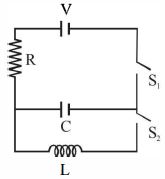
In an $LCR $ circuit as shown below both switches are open initially. Now switch $S_1$ is closed, $S_2$ kept open. ( $q$ is charge on the capacitor and $\tau = RC$ is Capacitive time constant). Which of the following statement is correct?
A particle of mass $0.1 \,kg$ is subjected to a force which varies with distance as shown in fig. If it starts its journey from rest at $x = 0$, its velocity at $x = 12\,m$ is .......... $m/s$