Question
Consider a neutron and an electron bound to each other due to gravitational force. Assuming Bohr's quantization rule for angular momentum to be valid in this case, derive an expression for the energy of the neutron-electron system.

Answer

$\text{m}_\text{e}\text{Vr}=\frac{\text{nh}}{2\pi}\ ...(\text{i})$
$\frac{\text{GM}_\text{n}\text{M}_\text{e}}{\text{r}^2}=\frac{\text{m}_\text{e}\text{V}^2}{\text{r}}$
$\frac{\text{GM}_\text{n}}{\text{r}}=\text{v}^2\ ...(\text{ii})$
Squaring (ii) and dividing it with (i)
$\frac{\text{m}_\text{e}^2\text{v}^2\text{r}^2}{\text{v}^2}=\frac{\text{n}^2\text{h}^2\text{r}}{4\pi^2\text{Gm}_\text{n}}$
$\text{me}^2\text{r}=\frac{\text{n}^2\text{h}^2\text{r}}{4\pi^2\text{Gm}_\text{n}}$
$\text{r}=\frac{\text{n}^2\text{h}^2\text{r}}{4\pi^2\text{Gm}_\text{n}\text{me}^2}$
$\text{v}=\frac{\text{nh}}{2\pi\text{rm}_\text{e}}$ [from (i)]
$\text{v}=\frac{\text{nh4}\pi^2\text{GM}_\text{n}\text{M}^2_\text{e}}{2\pi\text{M}_\text{e}\text{n}^2\text{h}^2}=\frac{2\pi\text{GM}_\text{n}\text{M}_\text{e}}{\text{nh}}$
$\text{KE}=\frac{1}{2}\text{m}_\text{e}\text{V}^2$
$=\frac{1}{2}\text{m}_\text{e}\frac{\big(2\pi\text{GM}_\text{n}\text{M}_\text{e}\big)^2}{\text{nh}}=\frac{4\pi^2\text{G}^2\text{M}^2_\text{n}\text{M}^3_\text{e}}{2\text{n}^2\text{h}^2}$
$\text{PE}=\frac{-\text{GM}_\text{n}\text{M}_\text{e}}{\text{r}}$
$=\frac{-\text{GM}_\text{n}\text{M}_\text{e}4\pi^2\text{GM}_\text{n}\text{M}^2_\text{e}}{\text{n}^2\text{h}^2}=\frac{-4\pi^2\text{G}^2\text{M}^2_\text{n}\text{M}^3_\text{e}}{\text{n}^2\text{h}^2}$
Total energy $=\text{KE}+\text{PE}=\frac{2\pi^2\text{G}^2\text{M}^2_\text{n}\text{M}^3_\text{e}}{2\text{n}^2\text{h}^2}$

Need a full question paper?

Generate a complete, print-ready paper with questions like this in minutes — across 16+ boards, with answer keys.
Start Generating Free

Similar questions

Two equal charges, $2.0 \times 10^{-7}C$ each, are held fixed at a separation of $20\ cm.$ A third charge of equal magmtude is placed midway between the two charges. It is now moved to a point $20\ cm$ from both the charges. How much work is done by the electric field durmg the process?
  1. Derive an expression for the average power consumed in a series $\ce{LCR}$ circuit connected to $a.c.$ source in which the phase difference between the voltage and the current in the circuit is $\phi$.
  2. Define the quality factor in an a.c. circuit. Why should the quality factor have high value in receiving circuits? Name the factors on which it depends.
A gas is initially at a pressure of $100\ kPa$ and its volume is $2.0m^3.$ Its pressure is kept constant and the volume is changed from $2.0m^3$ to $2.5m^3.$ Its volume is now kept constant and the pressure is increased from $100\ kPa$ to $200\ kPa.$ The gas is brought back to its initial state, the pressure varying linearly with its volume.
  1. Whether the heat is supplied to or extracted from the gas in the complete cycle?
  2. How much heat was supplied or extracted?
Two small spheres, each having a mass of 20g, are suspended from a common point by two insulating strings of length 40cm each. The spheres are identically charged and the separation between the balls at equilibrium is found to be 4cm. Find the charge on each sphere.
Find the magnetic field B at the centre of a rectangular loop of length l and width b, carrying a current i.
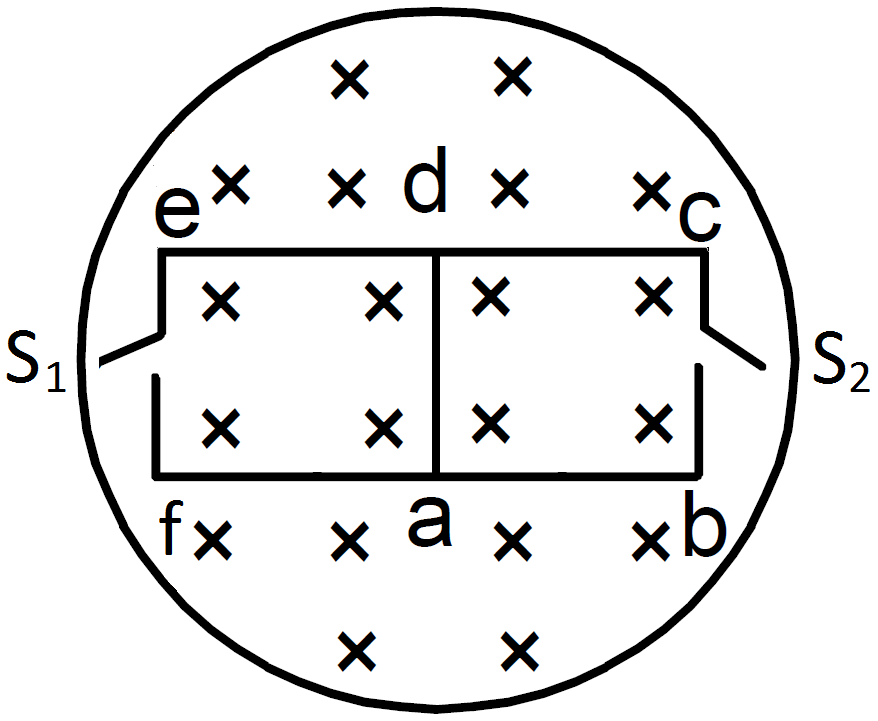
The magnetic field in the cylindrical region shown in figure increases at a constant rate of $20.0mT/s$. Each side of the square loop abcd and defa has a length of $1.00cm$ and a resistance of $4.00\Omega.$ Find the current $($magnitude and sense$)$ in the wire ad if:
$\text{ }^{212}_{33}\text{Bi}$ can disintegrate either by emitting an $\alpha-$ particle of by emitting a $\beta^-$ particle.
  1. Write the two equations showing the products of the decays.
  2. The probabilities of disintegration $\alpha$ and $\beta -$ decays are in the ratio $\frac{7}{13}.$ The overall half $-$ life of $^{212}Bi$ is one hour. If $1g$ of pure $^{212}Bi$ is taken at $12.00$ noon, what will be the composition of this sample at $1P.m$. the same day?
A simple pendulum of length $I$ is suspended through the ceiling of an elevator. Find the time period of small oscillations if the elevator,
  1. Is going up with an acceleration $a_0$
  2. Is going down with an acceleration $a_0$.
  3. Is moving with a uniform velocity.
  1. Derive an expression for drift velocity of electrons in a conductor. Hence, deduce Ohm's law.
  2. A wire whose cross-sectional area is increasing linearly from its one end to the other, is connected across a battery of V volts.
Which of the following quantities remain constant in the wire?
  1. Drift speed.
  2. Current density.
  3. Electric current.
  4. Electric field.
Two capacitors of capacitances $20.0pF$ and $50.0pF$ are connected in series with a $6.00V$ battery. Find:
  1. The potential difference across each capacitor.
  2. The energy stored in each capacitor.