MCQ
Consider a particle of mass $m$ having linear momentum $\vec p$ at position $\vec r$ relative to the origin $O$ . Let $\vec L$ be the angular momentum of the particle with respect the origin. Which of the following equations correctly relate $(s)\, \vec r,\,\vec p$ and $\vec L$ ?
  • A
    $\frac{{d\vec L}}{{dt}} + \vec r\, \times \frac{{\overrightarrow {dp} }}{{dt}} = 0$
  • B
    $\frac{{d\vec L}}{{dt}}\, + \,\frac{{\overrightarrow {dr} }}{{dt}} \times \vec p = 0$
  • C
    $\frac{{d\vec L}}{{dt}}\, - \,\frac{{\overrightarrow {dr} }}{{dt}} \times \vec p = 0$
  • $\frac{{d\vec L}}{{dt}}\, - \vec r \times \frac{{\overrightarrow {dp} }}{{dt}} = 0$
Answer

Correct option: D.
$\frac{{d\vec L}}{{dt}}\, - \vec r \times \frac{{\overrightarrow {dp} }}{{dt}} = 0$
d
As $\overrightarrow{\mathrm{L}}=\overrightarrow{\mathrm{r}} \times \overrightarrow{\mathrm{p}}$

Differentiate both sides with respect to time, we get

$\frac{\mathrm{d} \overrightarrow{\mathrm{L}}}{\mathrm{dt}}=\frac{\mathrm{d}}{\mathrm{dt}}(\mathrm{\vec r} \times \overrightarrow{\mathrm{p}})$

$=\frac{d \vec r}{d t} \times \vec{p}+\vec{r} \frac{\overrightarrow{d p}}{d t}$

$=\overrightarrow{\mathrm{r}} \times \frac{\overrightarrow{\mathrm{dt}}}{\mathrm{dt}}\left(\because \frac{\overrightarrow{\mathrm{dr}}}{\mathrm{dt}} \times \overrightarrow{\mathrm{p}}=0\right)$

$\frac{d \vec{L}}{d t}-\vec{r} \times \frac{\vec{d p}}{d t}=0$

Need a full question paper?

Generate a complete, print-ready paper with questions like this in minutes — across 16+ boards, with answer keys.

Start Generating Free

Similar questions

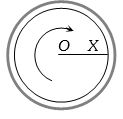
The diagram shows a cup of tea seen from above. The tea has been stirred and is now rotating without turbulence. A graph showing the speed $ v$ with which the liquid is crossing points at a distance $ X$  from $O $ along a radius $XO$  would look like
A man is crossing a river flowing with velocity of $5\, m/s$. He reaches a point directly across at a distance of $60\, m$ in $5\, sec$. His velocity in still water should be........$m/s$
Which of the following has neither units nor dimensions?
A light string passes over a frictionless pulley. To one of its ends a mass of $6\, kg$ is attached. To its other end a mass of $10\, kg$ is attached. The tension in the thread will be ........ $N$
Two satellites $s_1 \,\&\, s_2$ of equal masses revolve in the same sense around a heavy planet in coplanar circular orbit of radii $R\, \& \,4R$
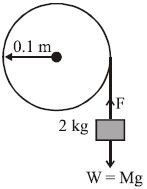
The moment of inertia of a solid flywheel about its axis is $0.1\,kg-m^2$. A tangential force of $2\,kg\,wt$. is applied round the circumference of the flyweel with the help of a string and mass arrangement as shown in the figure. If the radius of the wheel is $0.1\,m,$ find the angular acceleration of the solid fly wheel (in $rad/sec^2$)
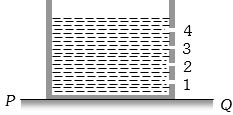
A cylindrical vessel of $90 cm$  height is kept filled upto the brim. It has four holes $ 1, 2, 3, 4$  which are respectively at heights of $20 cm, 30 cm, 45 cm $ and $50 cm$  from the horizontal floor $PQ.$  The water falling at the maximum horizontal distance from the vessel comes from
A bullet of $10\, {g}$, moving with velocity $v$, collides head-on with the stationary bob of a pendulum and recoils with velocity $100 \, {m} / {s}$. The length of the pendulum is $0.5\, {m}$ and mass of the bob is $1\, {kg}$. The minimum value of $v=$ $....{m} / {s}$ so that the pendulum describes a circle. (Assume the string to be inextensible and ${g}=10\, {m} / {s}^{2}$ )
A liquid of density $750\,kgm ^{-3}$ flows smoothly through a horizontal pipe that tapers in crosssectional area from $A _{1}=1.2 \times 10^{-2}\,m ^{2}$ to $A_{2}=\frac{A_{1}}{2}$. The pressure difference between the wide and narrow sections of the pipe is $4500\,Pa$. The rate of flow of liquid is________$\times 10^{-3}\,m ^{3} s ^{-1}$
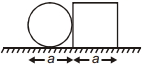
A circular plate of diameter ' $a$ ' is kept in contact with a square plate of side $a$ as shown. The density of the material and the thickness are same everywhere. The centre of mass of composite system will be ...........