Question
Consider a radioactive nucleus A which decays to a stable nucleus C through the following sequence:
A → B → C
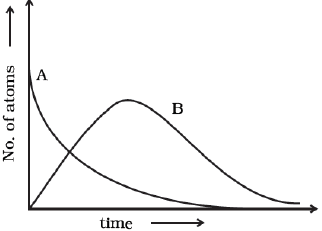
Here B is an intermediate nuclei which is also radioactive. Considering that there are $N_0$ atoms of A initially, plot the graph showing the variation of number of atoms of A and B versus time.
Answer

Consider the situation shown in the graph.

At t = 0, NA = NO while NB = 0. As time increases, NA falls off exponentially, the number of atoms of B increases, becomes maximum and finally decays to zero at ∞ (following exponential decay law).

Need a full question paper?

Generate a complete, print-ready paper with questions like this in minutes — across 16+ boards, with answer keys.

Start Generating Free

Similar questions

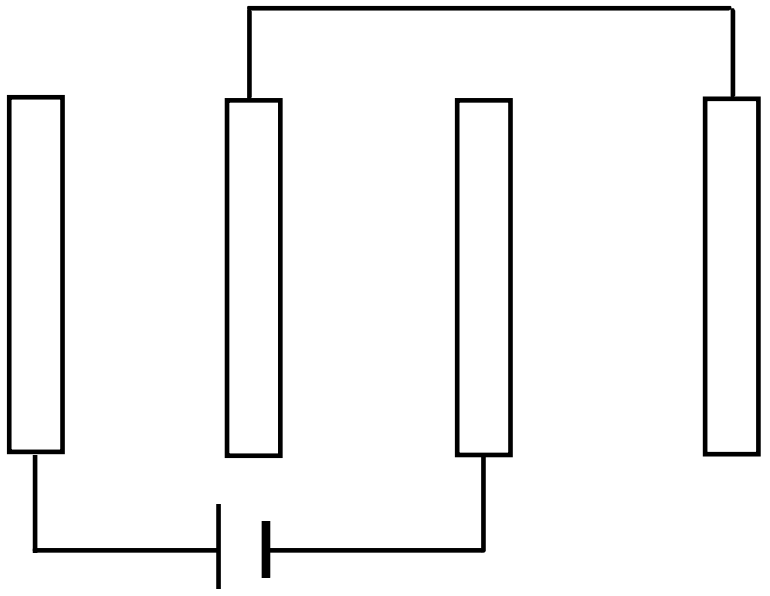
Each of the plates shown in figure has surface area $\Big(\frac{96}{\in_0}\Big)\times10^{-12}\text{Fm}$ on one side and the separation between the consecutive plates is 4.0mm. The emf of the battery connected is 10 volts. Find the magnitude of the charge supplied by the battery to each of the plates connected to it.
A mosquito is sitting on an L.P. record disc rotating on a turn table at $33\frac{1}{3}$ revolutions per minute. The distance of the mosquito from the centre of the turn table is 10cm. Show that the friction coefficient between the record and the mosquito is greater than $\frac{\pi^2}{81}.$ Take $g =10 m/s^2.$
Explain isotopes, isobars, isotones and isomers by giving examples.
It is sometimes heard that inertial frame of reference is only an ideal concept and no such inertial frame actually exists. Comment.
  1. For a glass prism $(\mu =\sqrt{3} )$ the angle of minimum deviation is equal to the angle of the prism. Calculate the angle of the prism.
  2. Draw ray diagram when incident ray falls normally on one of the two equal sides of a right angled isosceles prism having refractive index $\mu = \sqrt{3} . $
Draw a propagation diagram of a linearly polarized electromagnetic wave and write any two characteristics of electromagnetic wave.Magnitude of magnetic field associated with an electromagnetic wave in vacuum is $B_0=50 \times 10^{-8} T$. Write the magnitude of electric field associated with the wave in volt/meter
A short bar magnet has a magnetic moment of $0.48\ J\ T^{–1}$. Give the direction and magnitude of the magnetic field produced by the magnet at a distance of 10 cm from the centre of the magnet on.(a) the axis, (b) the equatorial lines (normal bisector) of the magnet.
A thin spherical shell lying on a rough horizontal surface is hit by a cue in such a way that the line of action passes through the centre of the shell. As a result, the shell starts moving with a linear speed v without any initial angular velocity. Find the linear speed of the shell after it starts pure rolling on the surface.
Calculate the energy that can be obtained from 1kg of water through the fusion reaction
$^2H + ^2H → ^3H + p.$
Assume that $1.5 \times 10^{-2}%$ of natural water is heavy water $D_2O$ (by number of molecules) and all the deuterium is used for fusion.
Let AE denote the energy gap between the valence band and the conduction band. The population of conduction electrons (and of the holes) is roughly proportional to $\text{e}^{\frac{-\Delta\text{E}}{2\text{kT}}}.$ Find the ratio of the concentration of condu.ction electrons in diamond to that in silicon at room temperature 300K. $\Delta\text{E}$ for silicon is 1.1eV and for diamond is 6.0eV. How many conduction electrons are likely to be in one cubic metre of diamond?