MCQ
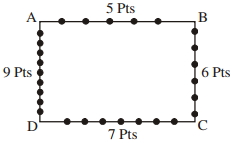
Consider a rectangle $ABCD$ having $5,7,6,9$ points in the interior of the line segments $AB,CD , BC , DA$ respectively. Let $\alpha$ be the number of triangles having these points from different sides as vertices and $\beta$ be the number of quadrilaterals having these points from different sides as vertices. Then $(\beta-\alpha)$ is equal to :
  • A
    $795$
  • B
    $1173$
  • C
    $1890$
  • $717$

Answer

Correct option: D.
$717$
d
$\alpha=$ Number of triangles

$\alpha=5 \cdot 6 \cdot 7+5 \cdot 7 \cdot 9+5 \cdot 6 \cdot 9+6 \cdot 7 \cdot 9$

$\quad=210+315+270+378$

$\quad=1173$

$\beta=$ Number of Quadrilateral

$\beta=5 \cdot 6 \cdot 7 \cdot 9=1890$

$\beta-\alpha=1890-1173=717$

Need a full question paper?

Generate a complete, print-ready paper with questions like this in minutes — across 16+ boards, with answer keys.

Start Generating Free

Similar questions

If ${S_1},\;{S_2},\;{S_3},...........{S_m}$ are the sums of $n$ terms of $m$ $A.P.'s$ whose first terms are $1,\;2,\;3,\;...............,m$ and common differences are $1,\;3,\;5,\;...........2m - 1$ respectively, then ${S_1} + {S_2} + {S_3} + .......{S_m} = $
Let $n(A)=m$, and $n(B)=n$, Then the total number of non-empty relations that can be defined from $A$ to $B$ is:
Choose the correct answer. The number of different four digit numbers that can be formed with the digits 2, 3, 4, 7 and using each digit only once is
Two finite sets have m and n elements. The number of elements in the power set of first set is 48 more than the total number of elements in power set of the second set. Then, the values of m and n are:
Circles are drawn on chords of the rectangular hyperbola $ xy = c^2$  parallel to the line $ y = x $ as diameters. All such circles pass through two fixed points whose co-ordinates are :
Two dice are thrown together. The probability that at least one will show its digit greater than 3 is:
If $\alpha$ and $\beta$ are the roots of the equation $x ^{2}+ px +2=0$ and $\frac{1}{\alpha}$ and $\frac{1}{\beta}$ are the roots of the equation $2 x^{2}+2 q x+1=0,$ then $\left(\alpha-\frac{1}{\alpha}\right)\left(\beta-\frac{1}{\beta}\right)\left(\alpha+\frac{1}{\beta}\right)\left(\beta+\frac{1}{\alpha}\right)$ is equal to 
The equation of the circle with centre on $x$ - axis, radius $5$ and passing through the point $(2, 3)$, is
The smallest positive integer n for which $ \text{n}!<\Big(\frac{\text{n}+1}{2}\Big)\text{n}$ holds, is:
If all the words (with or without meaning) having five letters, formed using the letters of the word $SMALL$ and arranged as in a dictionary; then the position of the word $SMALL$ is :