Question
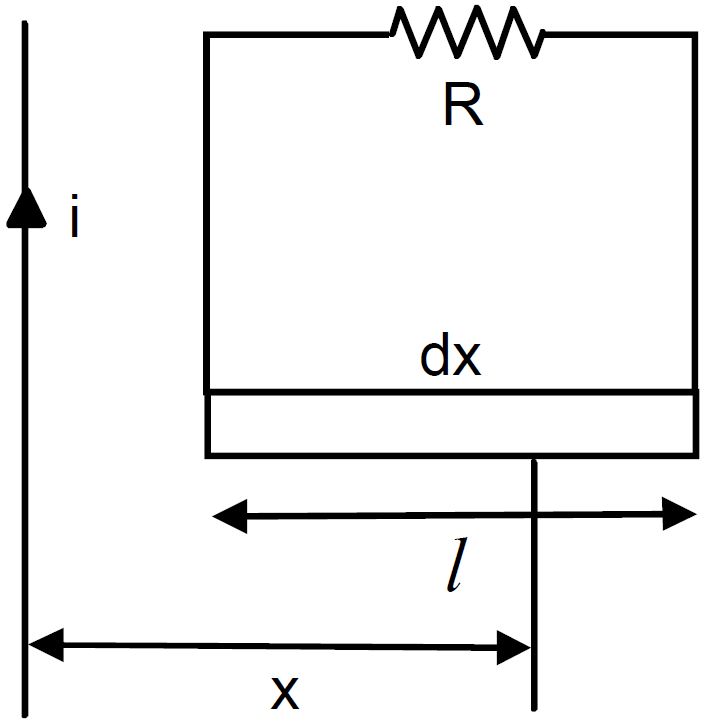
Consider a situation similar to that of the previous problem except that the ends of the rod slide on a pair of thick metallic rails laid parallel to the wire. At one end the rails are connected by resistor of resistance R.
  1. What force is needed to keep the rod sliding at a constant speed v?
  2. In this situation what is the current in the resistance R?
  3. Find the rate of heat developed in the resistor.
  4. Find the power delivered by external agent exerting the force on the rod.
Answer


  1. Emf produced due to the current carrying wire $=\frac{\mu_0\text{vi}}{2\pi}\text{In}\Big(\frac{2\text{x}+\text{l}}{2\text{x}-\text{l}}\Big)$
Let current produced in the rod $=\text{i}'=\frac{\mu_0\text{iv}}{2\pi\text{R}}\text{In}\Big(\frac{2\text{x}+\text{l}}{2\text{x}-\text{l}}\Big)$

Force on the wire considering a small portion dx at a distance x

$\text{dF}=\text{i}'\text{B}\text{l} $

$\Rightarrow\text{dF}=\frac{\mu_0\text{iv}}{2\pi\text{r}}\text{In}\Big(\frac{2\text{x}+\text{l}}{2\text{x}-\text{l}}\Big)\times\frac{\mu_0\text{i}}{2\pi\text{x}}\times\text{dx}$

$\Rightarrow\text{dF}=\Big(\frac{\mu_0\text{i}}{2\pi}\Big)^2\frac{\text{V}}{\text{R}}\text{In}\Big(\frac{2\text{x}+\text{l}}{2\text{x}-\text{l}}\Big)\frac{\text{dx}}{\text{x}}$

$\Rightarrow\text{F}=\Big(\frac{\mu_0\text{i}}{2\pi}\Big)^2\frac{\text{V}}{\text{R}}\text{In}\Big(\frac{2\text{x}+\text{l}}{2\text{x}-\text{l}}\Big)\int\limits^{\text{x}+\frac{\text{t}}{2}}_{\text{x}-\frac{\text{t}}{2}}\frac{\text{dx}}{\text{x}}$

$=\Big(\frac{\mu_0\text{i}}{2\pi}\Big)^2\frac{\text{V}}{\text{R}}\text{In}\Big(\frac{2\text{x}+\text{l}}{2\text{x}-\text{l}}\Big)\text{In}\Big(\frac{2\text{x}+\text{l}}{2\text{x}-\text{l}}\Big)$

$=\frac{\text{V}}{\text{R}}\Big[\frac{\mu_0\text{i}}{2\pi}\text{In}\Big(\frac{2\text{x}+\text{l}}{2\text{x}-\text{l}}\Big)\Big]^2$
  1. Current $=\frac{\mu_0\text{In}}{2\pi\text{R}}\text{In}\Big(\frac{2\text{x}+\text{l}}{2\text{x}-\text{l}}\Big)$
  2. Rate of heat developed $=\text{i}^2\text{R}$
$=\Big[\frac{\mu_0\text{iv}}{2\pi\text{R}}\Big(\frac{2\text{x}+\text{l}}{2\text{x}-\text{l}}\Big)\Big]^2\text{R}=\frac{1}{\text{R}}\Big[\frac{\mu_0\text{iv}}{2\pi}\text{In}\Big(\frac{2\text{x}+\text{l}}{2\text{x}-\text{l}}\Big)^2\Big]$
  1. Power developed in rate of heat developed $=\text{i}^2\text{R}$
$=\frac{1}{\text{R}}\Big[\frac{\mu_0\text{vi}}{2\pi}\text{In}\Big(\frac{2\text{x}+\text{l}}{2\text{x}-\text{l}}\Big)\Big]^2$

Need a full question paper?

Generate a complete, print-ready paper with questions like this in minutes — across 16+ boards, with answer keys.

Start Generating Free

Similar questions

A particle is thrown over a triangle from one end of a horizontal base that grazing the vertex falls on the other end of the base. If $\alpha$ and $\beta$ be the base angles and $\theta$ the angle of projection; prove that: $\tan\theta=\tan\alpha+\tan\beta.$
The current in a conductor and the potential difference across its ends are measured by an ammeter and a voltmeter. The meters draw negligible currents. The ammeter is accurate but the voltmeter has a zero error (that is, it does not read zero when no potential difference is applied). Calculate the zero error if the readings for two different conditions are 1.75A, 14.4V and 2.75A, 22.4V.
A gas is taken along the path AB as shown in figure. If 70cal of heat is extracted from the gas in the process, calculate the change in the internal energy of the system.
State Bernoulli's theorem. Using it how can you explain the functioning of a venturimeter to find velocity of flow of liquid through a tube?
Answer the following:
What is the temperature of the triple-point of water on an absolute scale whose unit interval size is equal to that of the Fahrenheit scale?
A stone loses $\frac{1}{10}\text{th}$ of its velocity on passing through a sand bag of length x. For its velocity to be made zero, how many more similar bags are to be placed on its path?
A body is projected at an angle o upward with the horizontal:
  1. Obtain the condition for maximum horizontal range.
  2. Prove that horizontal range of projectile is same when fired at an angle $\theta$ and $(90^\circ-\theta)$ with the horizontal.
  3. Obtain an expression for velocity of projectile at any instant t.
Mention the statements of the second law of thermodynamics given by Kelvin Planck and Clausius. How are the statements similar to each other?
The velocity$-$displacement graph of a particle is shown in Fig.
  1. Write the relation between $v$ and $x$.
  2. Obtain the relation between acceleration and displacement and plot it.
Explain sound waves and write their properties.